Reflections of Myself
Once upon a time my housemate asked me if I wanted to join her in hanging ancestral photos in the house. I declined.
I have a very vivid imagination. My ancestors, friends… everyone lives in vivid mindscapes. It’s like having a bunch of channels I can tune into at any moment.
I can see my great-grandmother washing laundry with her old tub and wringer on the back porch, or tending her garden - still growing next to the house today. Though she died 15 years before my birth, I know her through stories. I can see beloved friends, several states away watching movies, working in the garden, or riding horses and motorcycles.
As long as there are no still photos about, they thrive in my mind and I can spend time with them there.
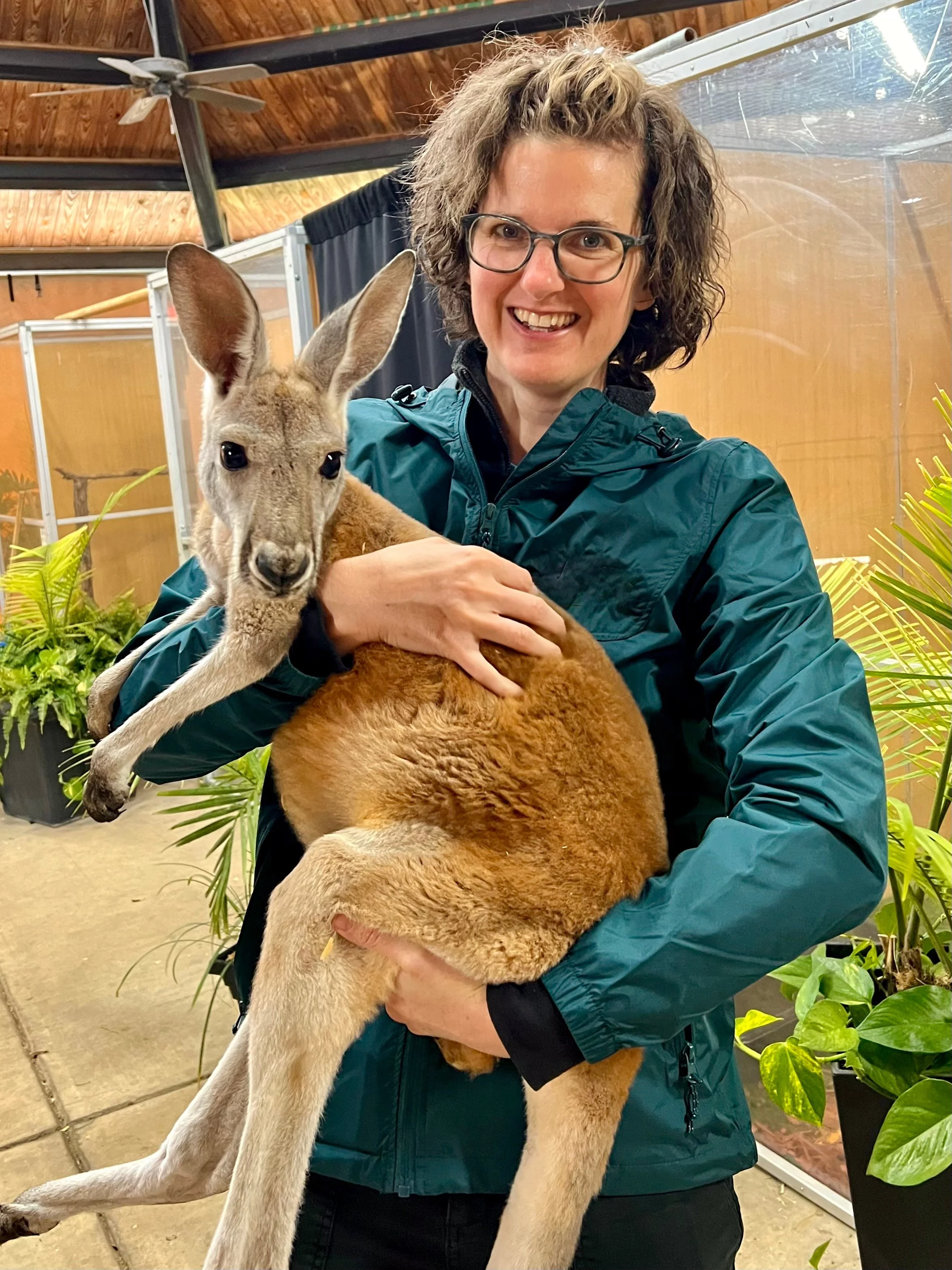
There are, however, a few portraits dotted about my home: a beloved snail and dog, both now passed on, and 3 portraits of myself as a kid. I’m thinking of them now bc there’s a fourth that will be added to them, one taken today holding a kangaroo - the joy on my face is unmistakable.
* * *
I struggled with anxiety all the years of my lived memory. Depression first started settling in around age 11. (That seems so young to me now - to be carrying such a load. I feel for that sweet, scared girl).
Left untreated, they grew, slowly at first, then more quickly. I sought help as best I knew how, but it wasn’t enough, and as it started escalating, I found myself in the darkest place I’ve ever been in (and hope never to return). Thankfully, I finally found the right combination of professionals to support me and I’ve been working my way back ever since.
There are two metrics here. Mental wellness is one, mental stability another. Because I went well past the mark of mental wellness into un-wellness - all the way to mental instability - mental wellness is no longer the only metric I monitor. The decades I spent doing my best to get by consisted of sporadic mental-wellness, culminating in sustained unwellness until mental stability itself gave way. The illusion of mental stability is no longer a “given” to me. That illusion was completely and irrevocably broken.
Through all of this - a lifetime of untreated anxiety and decades of intermittent depression - I was also living with undiagnosed neurodivergence that was impacting my life in ways I couldn’t begin to understand.
I will be managing all of these things - anxiety, depression, and neurodivergence - for the rest of my life. The difference is that now I have the right tools and information.
I will also likely spend the rest of my life managing the side-effects of so many years without adequate knowledge and support.
My nervous system and digestive system acutely feel the fallout of all the untreated years. I better understand nervous system dysregulation, and I’m learning how to reconnect with my body and its cues after decades of dissociation from it. I [mostly] eat in ways to support a digestion that’s always been somewhat delicate, but now also suffers from the long-term effects of untreated, chronic anxiety. I wonder if I’ll ever feel “whole” again and I have to make peace with it in case the fallout is permanent.
I practice noticing my thought patterns all the time, working to challenge unhealthy scripts and rewriting neural pathways in my brain. Yet I still have a really hard time seeing myself, connecting with myself, and separating my actual self (who is awesome and worthy of love) from all of the competing voices in my head that would tear me down instead.
* * *
That’s why I keep pictures of me around my studio and on my phone. The kid pictures remind me to be kind and gentle with myself. It’s hard to be mean to that precious kid that I have so much empathy for. I remember her joy and excitement and I remember her fear and shame. It’s literally impossible for me to be mean to her.
I keep recent photos of myself around because they remind me of times when I was happy. They tether me to joy if clouds roll into my mind. (Conversely, I avoid - and have at times outright deleted - photos of me during the Hardest Years and the Dark Months, bc it’s too transportive. I was terribly underweight because anxiety prevented me from eating much of anything, my smiles are small, and I look distant - haunted or hollow sometimes even.
But the pictures now show full, round cheeks and curves on my body - things I’m still getting used to. I lived in the underweight body for 4 years. Though it scared me at first because I lost the weight so fast, I grew used to it. I learned to feel comfortable in it. Though the photos now admittedly look too thin in retrospect, I felt pretty… because our culture rewards super f***ed up beauty ideals for women. Two years in, and I still work to accept my full cheeks and fuller body. And I still harbor a desire to lose at least some of the weight. My relationship with my body is always a work in progress.
But despite that dissonance, what is undeniable is that I see joy in photos of me now - true, radiant happiness in my eyes. The hollowness of body and spirit are gone and replaced with a fullness of life and joy. I keep these photos around to remind me of how far I’ve come, how much work and support it took to get there, and that each of those captured moments were real and I can trust them. If I dip into a melancholy moment or season, I can look to that evidence and know the sun will come out again and shine from within me.
* * *

Isn’t that something? I can spend time observing ancestral family members that I’ve never met, and friends near and far away, but I can’t see my own self. I need visual reminders to be kind, gentle, and playful with my inner child and to remember that when clouds roll in, health, vibrance, and joy can and will come again.
Without these reminders I get lost. I get lost in the old scripts - the mean ones that keep me so, so down and breed insecurity and smallness and suffering. But with these photos around, I can better stay on course and keep moving every day in ways that support wholeness, health, and peace (or at least neutrality when those feel like too much of a reach). These photos of myself are my map. Without them I would be lost.
* * *
It’s not been an easy road, but it’s one I can finally say I’m proud of.
I’m proud because I faced my demons every day for decades without adequate support and treatment. I kept living even when life felt like way too much. I am a survivor.
I’m proud because I take supportive steps daily, weekly, and monthly to keep me oriented towards healing and wellness. I show up. I do the work. I listen to others, learn, and practice.
I’m proud because I share my experiences with others. When I reframe my past as experience that can help others who are struggling, it helps ease the sorrow and regrets I feel about 40-ish years of Really Hard Stuff that I wasn’t equipped to deal with myself.
I am a survivor, an advocate, an educator, and a supporter and I feel dang good at it because I’ve learned it all in the trenches of life: what to do, what not to do, how to survive, and how to plot a course to recovery and then practice recovery and wellness every day.
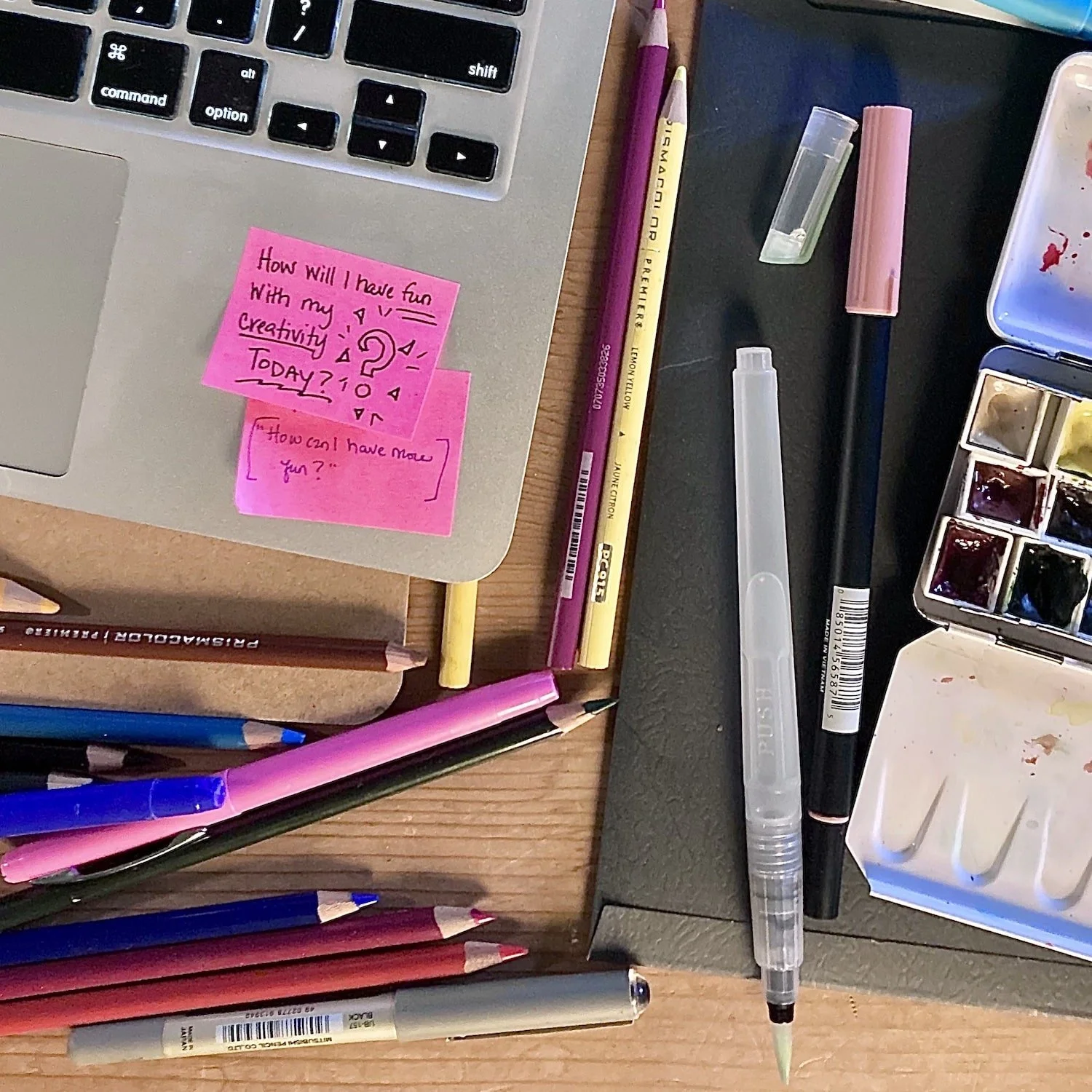
What do Artists do All Day?
I imagine there are many who have this question, because I used to wonder about it myself (for those curious about such things, I recommend Mason Currey’s Daily Rituals books). On occasion, I’ve been asked this question directly and I never know quite how to answer it because I just do what I do… I don’t really think about it, I just do it. So I thought I’d take some time and put these doings down into words. Maybe next time I’ll be better prepared when someone asks me what I’m up to!
On a typical weekday, I wake at 7:15 am, tend to the pups and my morning routine, then head to my studio at the end of the hall. I start by putting a few thoughts down into my journal about how I want the day to go and what I want to focus on that day, then I jump in with my first prioritized task.

The day’s work can vary depending on what types of projects I’m working on - currently, I’m prepping for an upcoming Zine fest. While I have most of the zine drafts completed, they need a few final edits before I print and assemble them. I’m also in the early development stages of an additional zine in hopes of getting one more done before the fest. Nothing about zine making is linear, so I’ve been spending my time on both sketching and writing - it’s still early in the drafting process.
That’s how art works: a seed of an idea, chased round with pen to paper, and round and round again. The process is like a spiral - starting on the outside, working your way round and round again with each subsequent draft until arriving in the center with a finished piece. It’s an imperfect spiral with an off-kilter center because there is no perfect process.
I find it helpful to split my days into blocks of time to be able to focus on creative projects, professional growth, business things, and client work. Managing the client and business side of art-making involves things like marketing, networking, website updates, and answering calls and emails. Professional development could mean attending a class or workshop to expand my skills, or setting time aside to brainstorm ways to grow my art practice or my business.
By the end of the workday, the pups are amped up and ready for dinner, Benjamin is in the kitchen prepping our evening meal, and we all take some time to relax together. If it’s been a particularly full day without much opportunity to dive into creativity, I may spend the evening with my sketchbook or journal in hand while we all listen to music and let night fall around us before bedtime.
The answers to this question are as diverse as there are makers in the world, but this is what daily life as an artist looks like for me. Saturdays are spent catching up on household chores and running errands, Sundays are a day for rest and relaxation, and weekdays are for working on this dream of being a working artist. I’m grateful for every day I get to spend at home with my animals working on creative projects.
Reflections on a Beach Day
As I descend down the steep slope towards the little pocket beach, my heart lightens in anticipation. The public beach is tucked into a high-end lakeshore neighborhood and hidden from the road above by vegetation and trees. A friend introduced me to it, that seems to be how one finds it, through a small social network of regulars.
On weekends, the grassy knoll fills up with towels and blankets packed in side by side. But on weekday afternoons, the sunny lawn is dotted with small groups of couples or friends - those fortunate to work alternate schedules or work from home who could take advantage of the sparse weekday crowds.
I arrived at just such a time. As I descended the steep slope, my eyes immediately started scanning for a favored spot: close to the shoreline, but off to the side near the shade of some trees so as to have sun and shade options on my blanket throughout the afternoon. This was my lucky day. Few of the regulars had arrived yet and I was able to tuck myself in right next to the rocky beach, at the edge of the grass, on the left-hand side of the park.
Situating myself along the side had other advantages as well. It helped me feel less conspicuous, giving me a vantage point to tuck myself away and people watch without engaging. Though people there were respectful and friendly, I still preferred to keep to myself or with my friend group this afternoon.
At the moment it was just me. I massaged sunscreen into my warm skin in liberal quantities - I planned on making a whole afternoon of it. I came prepared with reading materials and my journal, though I knew I'd give little, if any, attention to it. Beach days were transcendent days - beyond the usual pleasures I'd find at home. I stretched my body out on the blanket, situated my sunhat over my eyes and savored the warm sun on my skin. A delicate breeze, only slightly cooling, relieved the sun's constant beams and created a perfectly comfortable equilibrium.
With my eyes closed, I savored sun and breeze and listened to the waves lap against the shore. The sound of mingling voices wafted quietly over the sloped square lawn. I always savored the gentle hum of varied indistinguishable conversations with the odd exclamation or bubble of laughter. This day was no different. I was lulled into total relaxation by the soundscape under the warm August sun.
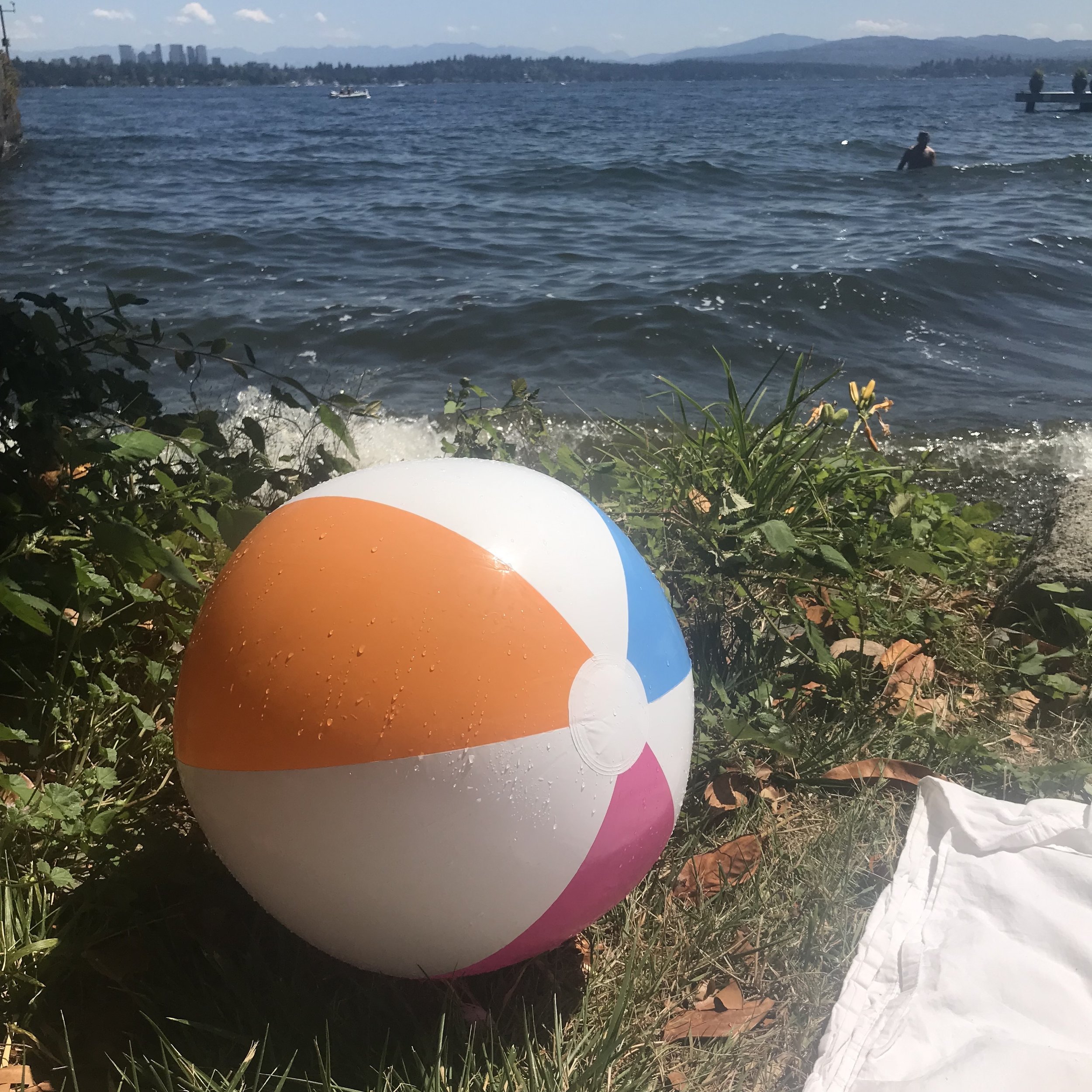
Fully warmed, the water called to me to wade in. I brought my beach ball, stripes of hot pink, electric orange, and cyan blue and rested it under my chest, hunched over it, legs dangling in the water savoring the gentle rocking of the waves. "Do not use as a flotation device" it admonished in stark, black print, but I never strayed farther from shore than I could easily swim, so it remained my faithful relaxation companion.
A few ducks swam by, careful to stay out of the reach of any human. A bald eagle soared overhead against the deep blue, cloudless sky. I turned my gaze back to the water line, looking towards the mountain rising out of the lake far off in the distance. A few clouds gathered around it, but above and around me it was all crystalline, clear blue sky.
The water had a bit of a silvery gray tinge to it, in contrast to the bright blue sky. The water's color was no doubt tempered by the earthy tones of the rocks and sediment beneath. I made my way back to the shore, stepping carefully over the rocks, my feet seeking the stepping stones set by a previous beachgoer as a hidden, barefoot-friendly pathway under the water.
The stone path wasn’t the only feature introduced by socially-minded beach visitors: an herb and flower garden ran the length of the shore where grass and rocky beach converged. Planted and tended by a handful of regulars, large plastic bottles were permanently stashed amongst the bushes along the side of the park to gather lake water to water them.
I passed through the garden and headed back to my blanket to lay in the sun again, hat shading eyes, to lose myself again in the rhythmic waves and the hum of commingling voices drifting over sun-dried grass. This was a ritual I'd repeat many times that day, and in many remaining summer days to come - a most embodied experience, completely at one with nature.
The Sparkling Gaze of a Dog
An author’s note about an ‘untranslatable words’ writing prompt:
Because writers are word-appreciators, I would like to share two words with y'all: saudade (Portuguese) and hiraeth (Welsh) because they are absolutely beautiful and worth knowing.
Saudade speaks to something of the union of nostalgia, longing, melancholy, and grief while also brushing up against the happiness and appreciation for the thing past that is now lost.
Hiraeth is also a word of longing, but specifically tied to place and time. Nostalgia or a deep longing for a place or time that may never have existed, or that may have existed only in one's memories or imagination - a distinct feeling of missing something irretrievably lost - a unique blend of place, time, and people that can never be recreated.
I tried to write about them first because they are the two untranslatable words that have consumed so much of my heart's journey the last four years, but I couldn't do it. The words, though very much felt, still remain untranslatable into English because my feelings and experiences still remain untranslatable from the inner landscape to the written word. So. Having attempted it, and once again finding myself writing in circles, confusing even myself, I redirected my efforts to a less charged writing prompt - a healing one in fact, and chose the word Ubuntu:
“I find my worth in you, and you find your worth in me.”

The Sparkling Gaze of a Dog
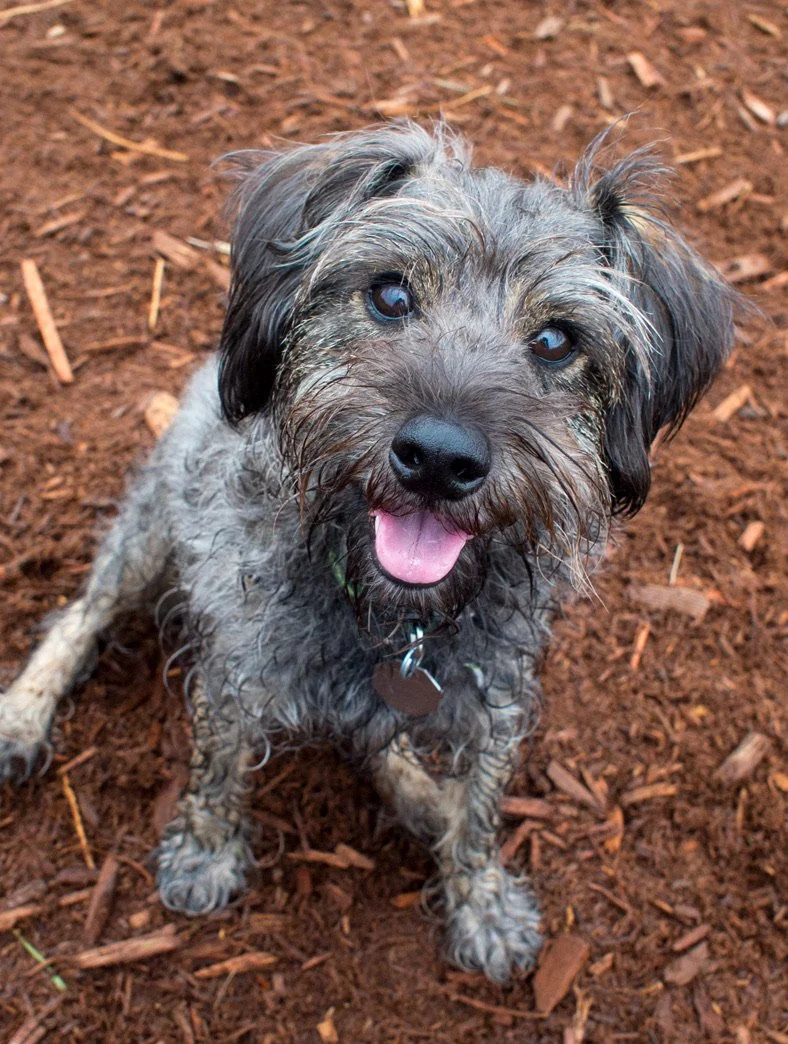
There are few gifts greater in this life than the intense and cheerful gaze of a dog at his human's face. Two dark, lively, sparkling orbs staring with focused attention, the mouth agape, pearly fang-toothed smile and flopping pink tongue - to be on the receiving end of such intensity fills one with immense love, gratitude and satisfaction.
A gaze like that is not freely given and is absolutely a mark of distinction. A dog gives such a gaze to those he is bonded with, to those he finds relevant because care and attention and love and respect have been offered from this human to the dog again and again and again. It is a bond rooted in trust.To say that I find my worth in my dogs is no understatement. They are the cadence of my day. Their internal clocks are so precise that they will wake me before, yet still in proximity to, my alarm clock. Their requests are few, but they prefer them to be timely. They know when it's time to eat, or go outside, or any of the other daily routines they've come to rely on in our household.
I find my comfort in them too. Their preference to be in the same room with me as I move about the house, or to curl up next to me as I lie across the bed reading or writing, or to curl up so tightly next to me when I sleep at night that I'm pressed in tight like a mummy under the covers as they seal me in on each side lying atop the blanket.
Thinking of ways to stimulate their young, inquisitive, intelligent minds and their youthful, lithe and lively bodies is another way my worth is found in them. I know they need me to help them navigate the human world they live in. So we practice manners and I encourage moderate reactions to the bicycles and cats they view from the bedroom window. We play chase and tug and fetch and go on outings when we can.
Is it too much of a stretch to imagine that they find their worth in me? Perhaps - for one can't truly know what goes on in their mind. But when I see their focused, happy gaze looking up at me waiting for their breakfast each morning, I wonder. When I see how my shepherd follows me, even if only in gaze, from room to room as he supervises my bedtime routine each night before escorting me to bed, I feel a sense of purpose behind it - like he does find worth in shepherding me, in staying abreast of all household activities and knowing where he perceives he's needed (and when he can relax in his favorite chair - but perhaps only for a while before coming to survey his home again to ensure all is as it should be). When my terrier jumps up into my lap and dramatically throws his little body against my chest, tummy bared, for rubs and pets, I am delighted by him. When he is wildly upset about the aforementioned bicycle or cat, he relies on me to help him re-regulate - on the intervention of physical touch, my hand on his back, or sometimes scooping him up, to reconnect him to the present moment and help him start to soothe.
We are interwoven, our family of humans, dogs and other smaller critters. But an even tighter weave exists amongst us three: me, the shepherd, and the terrier. We rely on each other in ways that exist outside of the rest of the human and animal family unit. Without them, my days would lose rhythm and have less meaning and purpose. Without me, their days would lose rhythm and they would miss their felt sense of purpose (to supervise, protect, alert, and flop over for pets!) - for they don't supervise or protect the other household human like they do me.
It's that distinction that I celebrate: the lived experience of ubuntu between us. It's not always easy between us - they're still growing up, and I don't always get things right, but our shared life feels absolutely right. I'm so grateful to we get to experience life together.
Dissonance
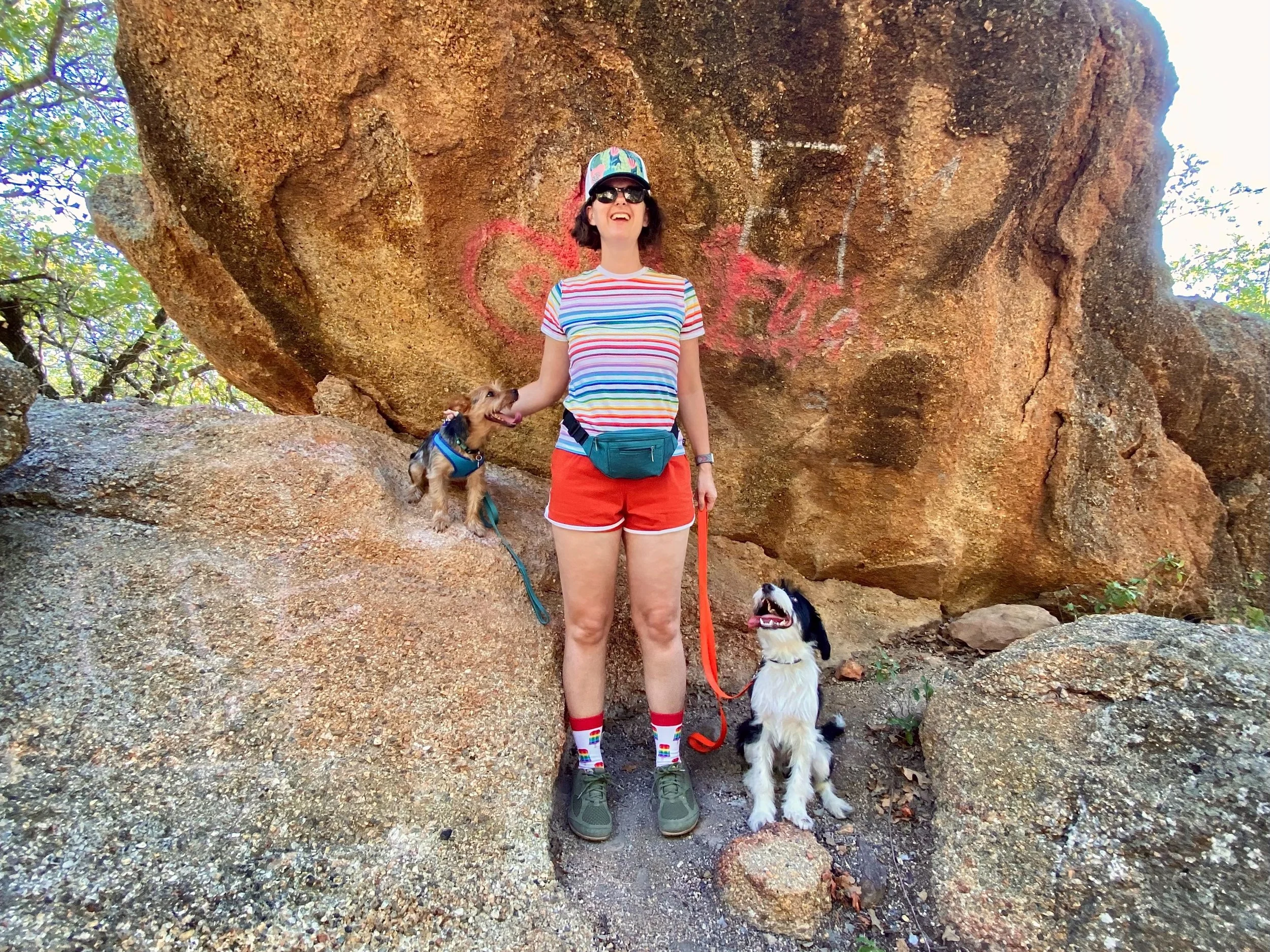
There you stand, smiling faces all around. First hike with your baby boys, all so smiley and satisfied from the adventure. You asked for this portrait, to commemorate the happy occasion of traipsing through woods together, obligingly taken by the one you married on this day eighteen years ago. The first family outing in four and a half long years after your beloved Pepper aged beyond the enjoyment of travel and then passed on, leaving just the two of you again.
Finally, a second opportunity to build a family: two boisterous pups, still new to the world and needing so much guidance, instruction and encouragement. But those grins, those toothy, tongue-lolling grins, and your joyful grin to match. Puppies are so much more work than you remembered - it's been seventeen years since you last raised a pup. But their warmth, their joy, their sparkling eyes focused intently on you, their effervescent personalities... it's everything you missed and savor having again.
You wore your new shirt and shorts to celebrate the occasion of this outing: cheerful rainbow stripes matching the excitement you felt when preparing to head out that morning. You wore rainbow socks to match, your favorite shoes, and a hat to keep your hair at bay.
You asked for this picture to be taken, you joyfully posed, and your pups even unexpectedly cooperated (no small feat for their wiggly bodies and curious minds). Your smile is radiant, one of pure joy. You look relaxed and comfortably at ease.
How mystifying then, that upon returning home and seeing the photo for the first time, you are drawn to the inadequacies you perceive instead: the cottage-cheese texture on your thighs, knobby knees, the veins protruding from your shin from a fifteen year old injury, the haircut that never was quite right sticking out of your hat like the straw on a scarecrow.
A picture-perfect moment of joy, delight, and all the hope and promise of starting a new family with your beloved and celebrating the day of your marriage - clouded over with an internalized sense of inadequacy, of imperfection, and of not being enough.
Saying that the cultural war against women's bodies has no place in a moment of such pleasure and delight is all well and good, but it doesn't undo four decades of acculturation telling you to be better, look better, hide any imperfection with all your might. The instinct to feel shame about your earthly vessel still remains.
So you struck a compromise. A quick caress from your Apple Pencil across pixelated flesh, and the veins disappear. With them eradicated, you realize the thighs really aren't so bad and the knees are okay - they're honest. You don't need to be perfect so much as you don't want a wandering eye to fixate on that which you deem the most undesirable. It's but one compromise, you say, in service of maintaining the joy of the overall image and avoiding some imagined, fixated distraction on one unsavory detail by some imagined viewer. Perhaps -- but it's also a small erasure of yourself and an acquiescence to the narrative that blemishes are synonymous with shame instead of markers of a life fully lived.
A Letter to My Mother's Hands
Your hands are soft, hardworking and determined. When I look at my hands, I see yours - when you look at your own, you see your mother's. Three generations of hands holding generations of memories. When did my hands begin to look like yours? One day I looked down and there they were: long, slender fingers, ivory skin speckled with darkening age spots, prominent tendons and blue vein paths traversing palms, fingers and dorsal planes.
The softness of your hands is one of their most memorable features, and yet it is a mystery to me. By my estimation, at a rate of three meals a day for 43 years, your hands have prepared a total of 47,085 meals). This estimate is low of course, as it doesn't account for all of the baked goods prepared for events, dishes made for large family gatherings, or all of the snacks that sustained your two active little ones.
Homemaking hands are hardworking hands: they feed family and community alike. They tend to the cleaning and maintaining of home and community spaces. Your hands do nothing halfway: cooking from scratch; washing pots, pans, and dishes by hand; and scrubbing, dusting and cleaning. By all calculations they should be toughened with time, yet their softness defies not only their actions, but also believability.
Your hands also cultivate beauty. They dig in the hard dry ground and nurture tender green beauty. They plant pansies each autumn in sweet memory of your mother, they feed and water the birds on even the coldest winter days, sow seeds each spring, and faithfully water every thirsty plant all summer long.
Your hands are instruments of determined curiosity as they experiment with new crochet patterns and techniques. When you lie in bed at night waiting for sleep to come, your hands are still at work in your mind as you sort out challenges in your needlework.
My love for your hands isn't borne out of this birdseye view of all that your hands have done in service to your family and community. My love is borne out of the very personal ways that your hands have held and cared for me - these are the memories I hold dear.
Your hands held me and rocked me. They held the many books that you read to me. They kneaded bread dough, crimped the edges of piecrust, and shaped balls of cookie dough to fill our home with the most wonderful aromas of freshly baked treats.
Your hands prepared peanut butter and graham cracker finger sandwiches served on the tray of the little blue plastic tea-set with cold milk that we poured ourselves from the little plastic tea-pot. They delivered this most favorite snack for us to enjoy at our own little picnic table in the backyard. Your hands planted the flowers in our yard that allowed me to grow up with a knowledge of flowering plants.
Your hands often worked late into the night to sew outfits for me, smock dresses, or to resolutely meet a deadline so that I could have an outfit for my book report the next day.
When I sustained what could have been a very scarring injury to my face, your hands fastidiously tended my wounds and scars (despite my protests as an impatient six-year-old) and ensured that no evidence would remain that any trauma ever occurred.
When I was anxious and scared, they rubbed my back. Even still, I love when you come up behind me and rub my shoulders with your hands. Though they're aging and losing some strength, you still offer this loving touch.
Your hands have long been one of my favorite features, and it's because of how they've cared for me all of my life. When my hands began looking like yours I didn't see age - instead I felt wonder. It is a gift to me that in looking down at my own hands, I should be reminded of the hands that have cared for me best all of my life.
It is a wonder to me that you should look at your hands and see the hands of your own mother who raised and nurtured you. Generations of love and sacrifice, most often unmentioned and unnoticed, held in these hands with our long, slender fingers, rippling tendons, and increasing age spots. What mystery is this that hands can hold so much?
Life and Death
Everything’s been all life and death. Of course this is the usual way of things, but I’ve never been so acutely dialed in to it as I have in the last year.
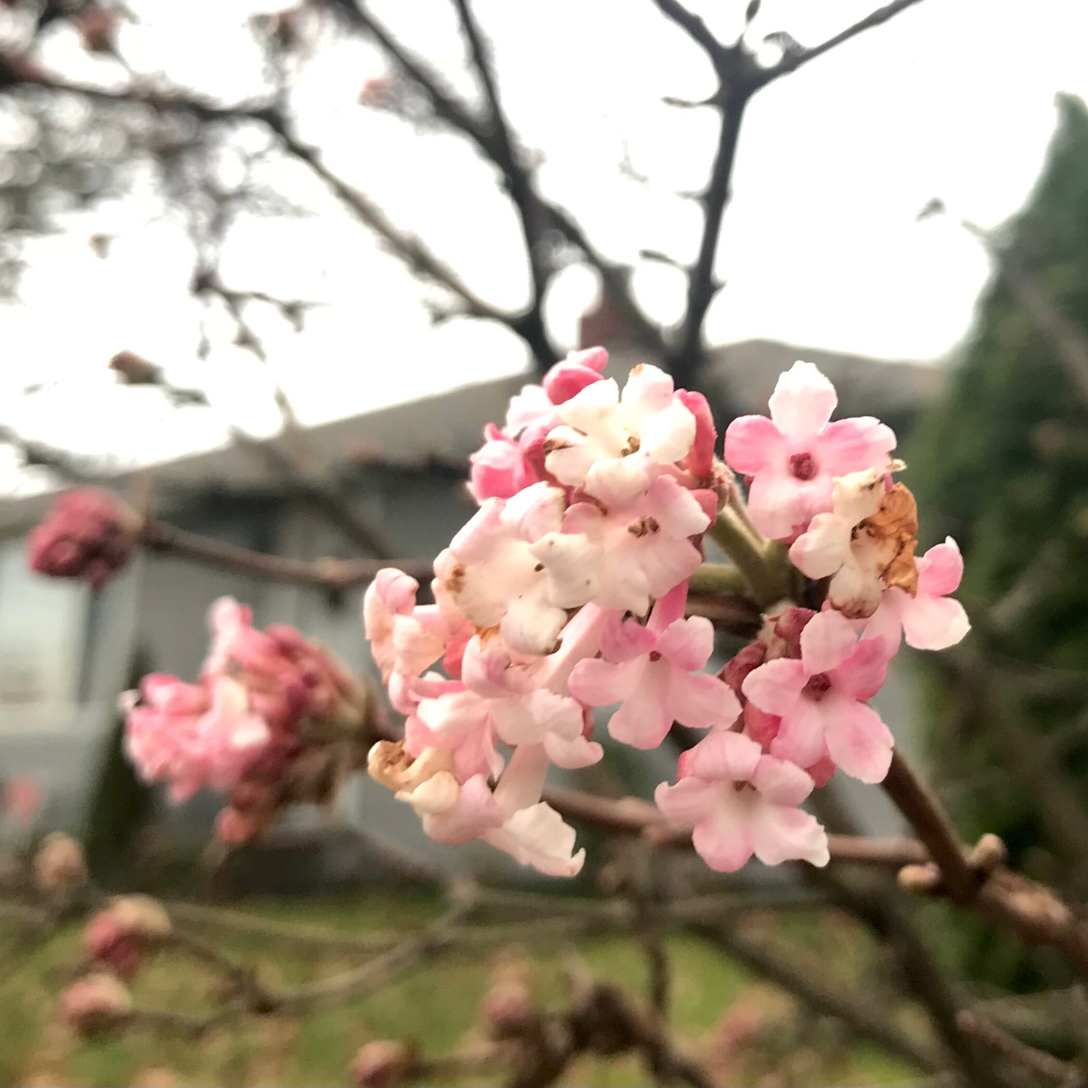
When the pandemic started it was the death of things as we knew them. Everything felt unsafe as things shut down and things were cancelled one after the other. I leaned real hard into the many signs of the coming spring around me to sustain me during that time of uncertainty. Buds on trees, bulbs peeking up out of the ground, and birds and squirrels darting about were my sustenance. That was in March.
The uncertainty and fear continued in April and May, as did the ever unfurling springtime season. Across the country my grandmother began to decline. At home, my dog declined as well. Although both of them were elderly, neither of these declines were expected. In June they died, 10 days apart. Because of the pandemic I wasn’t there to see my grandmother either before or after her death. Although I accept the reality of the situation, it will never be okay with me that I couldn’t be there. But, it was also an unexpected blessing because had I been there, I wouldn’t have been at home to facilitate my beloved dog’s transitions at the end of his life - and I will be forever grateful that I was able to be fully present with him in those last days.
Spring bloomed into sunny summer days and I learned of the death of a high school friend. Grief doesn’t care if it’s old news, grief washed over me when I heard of it although he’d already been gone for 3 years.
In a desperate attempt to cope with everything that threatened to overwhelm me last year, I threw myself into my work. As summer shifted into fall, my focus only intensified. My art practice has never been more constant or flourishing as a result. There’s so much life and vibrancy in it.
Winter’s mostly been dark and difficult. It’s marked the death of some relationships that aren’t what I thought they were. I’m reorienting my navigation and figuring out new ways to relate that are authentic and kind while also honoring myself and my needs.
Last week we received news that a former mentor of ours had died. It seemed extra sudden, as we’d only recently heard he was ill. He was an absolute light in the world and I’m struggling to accept that he’s no longer here. He was 65 - not nearly old enough to be gone already. More heartbreak to add to the pile.
I’ve thought a lot about the past year and wondered at how it could be the worst and the best all at the same time. There’s so many blessings and so much personal growth and also so much heart-rending loss, fear, and heartache. Death, loss, and the breaking of things (relationships, social and political norms) bring the rest of life into sharp focus. I’ve never loved nor appreciated my partner more. I’ve never felt such deep gratitude for a sunny February afternoon and given it so much appreciative and mindful attention. I’ve never felt so much hopeful expectation for my future - even as I still fear the unknown.
There’s so much from last year that I wish never happened, that I could somehow delete or undo, but I’m also amazed at how it’s shaped me and grateful for the ways I’ve learned and grown. It’s remarkable to me that (with time) I’m finding so many sprouts of life in the deaths of loved ones, relationships, and old ways of being.
Opossums & Woodpeckers
L—,
I was just thinking about you because of what I've been thinking through / up to this morning and how it segways with our visit last night. So I thought I'd walk you through some of my brain stuff this morning, so as to help provide you with more intel for your exploratory journey :)
So first, I love animals and since I was a kid I've generally preferred them to humans. The way I was talking about plants last night, and how they'll show up and say 'hey!' and that if you start interacting with them, you'll learn stuff from them, well the same is true for animals.
And they can show up in all manner of forms. Sometimes it's literal (like the rabbit that came to live in our backyard after Pepper died who has been a real balm to my soul! Rabbits are the animals I have the oldest spiritual relationship with), and sometimes it's figurative (like seeing an image of an animal anywhere out in the world that somehow catches your eye).
And so if we approach these appearances with the same curiosity that we do the plants and contemplate what we know about those animals (who they are: ie: where they live, what their behaviors are, etc) and seek more information about them, then we can learn from them.
So, for the last couple of years, I've been leaning heavily into the possum and its characteristics, but this morning, I was thinking through some insecurities / challenges and it led to me thinking about behaviors I've embodied that I've related to the possum that are no longer serving me well. And, to keep this story short, I realized that the main reason I was feeling limited by those attributes that I've been embodying from the possum, is because I'd only taken aspects of possum traits, not the wisdom of the whole creature. - I'd reduced it to my own narrow view (which I was also using as a device for shielding myself from feelings of discomfort and insecurity in both my internal landscape and outer social environment).
This realization helped me in a couple of ways. First of all, I've not been at all fair to possums. I've typecast and stereotyped them and used those stereotypes as defense mechanisms instead of working through my feelings of discomfort and insecurity. I need to do some inside work on myself to deal with those feelings. I also need to humbly re-approach the concept of 'possum' and learn from the whole animal... not just the parts I [unconsciously] handpicked for my own [maladaptive] benefit.
Which is how I found myself on my computer this morning doing a couple of searches. First of all, refamiliarizing myself with possums and their behaviors, adaptabilities, etc... not just what I've painted them to be in my own mind. Secondly, contemplating that maybe it's time to start working with another animal as well.
While considering what animal that might be, I started searching through a stack of animal illustrations I have. This activity didn't yield the answer directly (it's not like I was flipping through and then came across THE animal)... no, instead it allowed me a chance to free up my subconscious (I often like handling things in this manner... sorting, etc, as a means of letting subconscious thoughts poke through) and suddenly I knew exactly what animal I was curious to explore next.
Woodpeckers have been calling my attention for almost two years now, and it's only increased in frequency this summer. I hear the flickers outside all the time and I love hearing their calls! I love knowing when one is nearby and spotting them when I'm out on my walks. On a walk a few days ago a flicker flew by and straight-up landed on the side of a telephone poll and I marveled to myself 'how is that even possible?!' It seems too amazing... to come in at full flight speed and just land on the side of something so seemingly hard and solid. How??
So these contemplations and thoughts were what led me to the internet to brush up on what I know about possum behaviors (with a new humility of spirit... really being in a place to receive instead of putting my own agenda out there) and also to ask "how do woodpeckers land on the sides of trees."
Thus, this begins my journey of working with woodpeckers... I've already been noticing them for sometime. Then I had that curious question last week. Today when I was struggling with human/emotional/thought-pattern stuff, and I did my usual routine [ritual] of handling some illustrations in my hands, looking at them and contemplating them as a means of letting my subconscious speak up, it all came together... when I thought of the woodpecker, that curious question from the other day came back to me, and thus began my exploration :)
Other options available to me: I may watch some woodpecker videos on Youtube. It's a readily accessible place to observe animals in a concentrated form of study that would take a long time to track down in the wild. But this is supplemented with continuing to observe and listen to the flickers every single time I can in my daily life.
Also, I don't try to start from scratch (I'm not this strong yet at my practice) with figuring out what traits each of these animals has... I usually start with a quick google search about what symbolism others find in an animal and see what jives with me (some of it's esoteric bunk and doesn't seem to come out of anywhere but makebelieve, but some of it I read and I'm like 'yep, that jives with me from what I know about these animals from my own observations). - So, this morning when a google search suggested that a woodpecker "stands for strength, opportunity, wisdom, resilience, kindness, and determination. Never one to give up, it sees value in the most hopeless of things, including a dead tree and makes remarkable good come out of it." That gave me something I could start working with... I can see those traits myself (except for kindness, at this point I can't see what about a woodpecker's behavior could be interpreted that way), but the others I can see in the woodpecker's behavior).
AND, since those are traits I feel like I could use help with in strengthening my own character... I think it will be a good match for this next season as I reconcile with the possum and get to know the woodpecker better.
As I said last night, it's just recognizing that the plants and animals are our neighbors and then being curious and getting to know them (instead of othering them and placing ourselves above them).
ALSO, as one last nugget, I'll leave you with this tie-in. We talked briefly about ancestry and so that's also an element I contemplate and consider in different ways at different times. One way that I integrate that is that I remind myself that my ancestors in the British Isles would have been surrounded by different (yet similar) plant and animal neighbors than I am here. So again, I let myself be curious and I searched 'woodpeckers of the united kingdom' and in doing so, I learned that there's a gorgeous green woodpecker over there, in addition to a couple of other lovely varieties!
So I focus on being part of my local community by getting to know the plants and animals here. And I focus on being part of the global community by remembering that there's more out there than what's right in my face. It opens me up to more wonder (green woodpeckers!) and also to more need (the conservation efforts and struggles over there don't look so different from those here). It's a specific way that I can dial into caring for my non-human neighbors here and abroad - and it reminds me that I'm part of something bigger (and also not the center of the universe).
(Can you imagine if we all gave our time and attention to our adopted land and our lands of origin... which for me I count both as Texas and the British Isles... because they are the lands of my recent and distant ancestors)... how much healing that would bring to the planet and our relationship with it??)
So these are my thoughts of this morning and I wanted to share them with you in hopes that they can help light your path.
I'm so excited and hopeful for you for this grand adventure. Stay curious and open, my friend, and great things will find you! :)
A Prayer for a Better World
Every day I get up and work on building my skills as an artist. I’m a born communicator - my father will tell you I came into this world already talking. All my life I’ve communicated verbally, but the endlessly missed piece that I longed for was the ability to communicate visually too. I’ve been working towards that goal for the last couple of years, taking classes as I’m able, learning from books, and practicing on my own.
Now I’m living the long-held dream of waking up every day and going to work in my home studio (in a corner of my bedroom). I sit down at my desk and show up for myself and my dream of being an artist. I’m taking classes to bolster my development and am learning how to build daily routines and ongoing practices as a working artist.
Especially in these last couple of weeks this discipline has been fueled by the faith I have that I can make some difference in the world with these skills someday. I feel acutely that it is my task to work hard at building my skills as an illustrator for some future, not yet known, purpose - so I work on drawing exercises day after day.
But underneath the faith there have been feelings of desperation and hopelessness. In feeling hopeless about current events, I desperately sought the only solace and hope I could find - which was to pour myself into my art practice for some future purpose I can’t see but believe to be there. But a shift in perspective, thanks to a visit with a friend, helped me replace those undercurrents of desperation with hope.
She shared a quote with me from one of her colleagues:
“The work we do is a prayer for a better world.”
I already had strong faith in the pursuance of my work - that was unwavering. But now, instead of fueling that faith with desperation about all that I cannot control and hopelessness about all that I fear, I will seek to fuel my faith with hope. Instead of desperation I will center myself in the contemplative practice of imagining a better world and the role I can have in building it. The work will look the same - showing up at my desk day after day, building skills and workshopping concepts - but the energy behind it will be one that is of growth and hope instead of mere survival.
Is your work* a prayer for a better world? I’d love to hear more about how your work intersects with your hope for the future.
*In case this needs to be explicitly stated, your work is anything that you value and devote yourself to routinely, whether paid or not. My work as an artist is unpaid, but no less needed or valuable. The same may be true for you too.
Brain Ruts
A couple of weeks ago I was suddenly aware that I’ve been stuck for a while in negative thought patterns. I wasn’t sure when or how they started, but I realized they’d been around long enough to turn into brain ruts. Did you know that when your brain does something enough times in a row that it starts becoming entrenched? The brain is just looking to create the most efficient superhighway for the transmission of information by prioritizing commonly used pathways. The problem with this, however, is that it can become determinant. One day, if you’re lucky, you wake up to yourself and realize ‘I haven’t always been this person. I don’t want to do this anymore’ and you change your ways.
At some point, I went down a negative neural pathway in my brain. My brain made a note of it, maybe put up a guide sign so that future hikers could find the new path. The guide sign was effective and more and more thoughts tromped down that path until it became a rut and the previous path towards positivity became fully grown over!
Having realized I’ve been wearing down this path for some time now, and that it’s absolutely not the person I used to know myself to be, I resolved to climb out of the rut. Trying to work one’s way out of a well-entrenched brain-rut is hard enough because the path is worn deep. But it’s made more difficult because the only way out is to consciously and sustainedly choose the positive path for a long period of time instead of the time-worn negative one. The new path is hard to find and feels woefully unfamiliar. The thoughts long to meander along the cleared and tended path that’s already so freely available. Instead I must consciously choose to reject the easy path and guide them towards the jungle instead. There was a path there once, I remember it, but all feels unfamiliar to me now. Like trying to work an atrophied muscle, it takes concentration, willpower, and effort to stick with it and resist the lazy way out.
It’s hard to monitor our own thinking all the time, so we don’t notice when we make these diversions. What starts as a small diversion into unfamiliar territory can grow to become a place where we build a home and take up residence. I’ll never know when I took my first step down the darker path, but since I can’t remember a time when I haven’t been afraid or anxious about something, I now realize I was a prime candidate for heading down this road at some point. Passivity also played a role, simply because I didn’t realize the toll that these last four years have taken on me. The fear-mongering used by my country’s leader (and his opponents) no doubt encouraged these ruts to form as I grew increasingly hopeless about the world around me.
But I’m awake, aware and active now. I see that I’ve been residing in negativity and hopelessness. I see the effects of my thought-habits and the effects on the rhetoric around me. I see how I’m not the only one who’s grown glum and despairing and now recognize similar behaviors in some of my friends. Like frogs in a pot come to boil wondering when someone turned on the heat - when did we all get cooked?
Empowered with this self-realization, I’ve been actively working on exercising my atrophied positivity muscles as I rebuild a path to hope and optimism. When I have a negative thought, I reframe it. I’m practicing counting my blessings as a spiritual weight-lifting discipline. When I can’t find my way out of hopelessness or discouragement, I’m seeking others who can share some perspective.
In a recent visit with a friend, she told me about a character in The Hunger Games (which I definitely have not read. I can’t stomach dystopian vibes, I do a fine enough job of creating dystopian worlds on my own with my rogue imagination) - but I’m told there’s a character who has been brainwashed to hate, mistrust, and kill Katniss (whom he once loved). As he’s working to overcome his brainwashing, he uses his relationship with her as a compass to help him navigate his thoughts and learn what and how to trust again.
“My brain is telling me _____, is that true?” The recovering brainwashed character asks these questions of Katniss just as I ask these questions of my friend. “My brain is telling me there’s no hope for the future, is that true?” I will keep asking these questions as part of my deconstruction of the negative brain ruts and my reconstruction of the positive path.
What about you? Are there areas of negativity or hopelessness that need your attention? How can you reframe those thoughts - even if you don’t feel the positivity yet - and start building a path towards feeling positivity again someday? Who is the trusted friend in your life who can help you see the light when all you see is darkness?
Imagination for Good
Dear Friends,
I’ve been struggling with hopelessness - and I imagine I’m not alone. I can hardly conceive the reality of everything that’s going on in the United States right now (and globally), and all that has transpired during the last four years of our current U.S. presidency. I’m at a loss for words, for sense-making, and, most recently, hope. The future has felt increasingly bleak and I’ve felt overwhelmed by it all.
Thankfully, I have a few intimate friends that are safe to be completely myself with. I can be honest about my feelings of fear, despair, and hopelessness - and I can ask for help with shifting my perspective. I called one of those friends today and our conversation did much to help nudge me back on a healthy track. I decided to take to the keyboard to synthesize a few of the takeaways that I will be leaning into extra hard - and decided to share them here for anyone else who needs some community support as well.
In chapter 20 of Anne of Green Gables, Anne (who is well-known for her vibrant imagination) is going on about ghosts and ghouls to her conservative, religious caregiver, Marilla. Marilla replies thusly:
"Anne Shirley," interrupted Marilla firmly, "I never want to hear you talking in this fashion again. I've had my doubts about that imagination of yours right along, and if this is going to be the outcome of it, I won't countenance any such doings. You'll go right over to Barry's, and you'll go through that spruce grove, just for a lesson and a warning to you. And never let me hear a word out of your head about haunted woods again."
Anne might plead and cry as she liked--and did, for her terror was very real. Her imagination had run away with her and she held the spruce grove in mortal dread after nightfall. But Marilla was inexorable. She marched the shrinking ghostseer down to the spring and ordered her to proceed straightaway over the bridge and into the dusky retreats of wailing ladies and headless specters beyond.
"Oh, Marilla, how can you be so cruel?" sobbed Anne. "What would you feel like if a white thing did snatch me up and carry me off?"
"I'll risk it," said Marilla unfeelingly. "You know I always mean what I say. I'll cure you of imagining ghosts into places. March, now."
Anne marched. That is, she stumbled over the bridge and went shuddering up the horrible dim path beyond. Anne never forgot that walk. Bitterly did she repent the license she had given to her imagination. The goblins of her fancy lurked in every shadow about her, reaching out their cold, fleshless hands to grasp the terrified small girl who had called them into being.
The chapter is appropriately titled: A Good Imagination Gone Wrong - and it seems that’s exactly what has happened with mine.
My friend heard all of my fears - global, national, local, and personal - all of my doubts about the future and finding a way forward and she helped me see that my imagination was wielding me (instead of me wielding it). She likened it to riding a galloping horse: it’s very thrilling if you’ve got the reigns and are in control, but quite terrifying if you do not and you’re on the back of a runaway horse instead.
She reminded me that imagination is one of humanity’s superpowers - that nothing has ever been done, in the whole history of the world, without imagination. She encouraged me to put my imagination into hope for a better world. In moving into that space in my mind, I can envision a way forward. I take hold of the reigns and become re-empowered to effect change around me and become part of shaping the future.
My imagination is already constructing a story and although it’s been a hopeless one, the point is that I’m very practiced at doing imaginative work. She encouraged me to lean into that strength, flip the narrative, and then dwell there in the imagined future (where justice and peace prevail). She cautioned me against dwelling in the space of “how to get there.” To dwell in the ‘getting there’ space would contribute to ongoing exhaustion and burnout because it is a space of heavy emotional work. By dwelling in the hoped-for future space, I can gain fuel and emotional sustenance to power the work that must be done.
I’m not sure if I’m explaining it very well so that it can resonate with you, reader, as it did with me - so allow me to try this analogy. It’s the difference between where we build our homes and where we go to work. I can take up residence and be nurtured by a hopeful vision for the future. There are gardens there and nourishing sustenance, and places to rest and be restored. Each day I leave that home to go to work. The work is essential, necessary, valuable, stressful, challenging and, well, work. - but I don’t dwell there. If I did I wouldn’t be able to keep showing up day after day.
By encouraging me to take my imagination by the reigns and envision the world I hope to live in, my friend helped me step from powerless to superpowered.
Because I’ve felt overwhelmed (and therefore disempowered), I’ve not known where I fit in or what my unique role could be to help build a world of justice and peace. But each day I spend hours working to build my skills as an artist. The one thing I’ve found hope in is art. I don’t know yet how my art can make a difference, but I’ve been fueled by my faith that it will. I pay attention to others (artists, craftsmen, small-presses, comedians, vloggers) and watch how they take their skills and hobbies and transmute them into building blocks for justice and inclusivity. This is where I’ve found hope so far.
Now, I will put my imagination into hope for a better world. In doing so, I bet clarity will follow and I’ll get some ideas for how I can contribute towards building that future. Using my imagination for good is foundational work. By starting with this shifted mindset, the other pieces will follow and I will be able to approach my art practice from a place of curiosity about what’s possible instead of a place of desperation as I struggle to make sense of things and cope.
If you’ve been feeling hopeless or overwhelmed, I encourage you to check-in with yourself and see if you’ve lost the reigns of your imagination. Sometimes it can be hard to see that in ourselves - monitoring our own thoughts can be a challenge if we’re embedded in them. If that’s you, I hope you can find someone safe to talk to who can help you reign that runaway horse back in. But even more than that, I hope that you can imagine things that you can feel excited about. Excitement is an excellent fuel for hope.
The Love of God
It’s been 17 years since I started deconstruction from Christianity and 10 years since I left the church and the faith behind for good. The deconstruction process was lonely, alienating, terrifying, exhilarating, raging, relieving, life-affirming, and liberating. It was a whole hell of a lot of work. But on the other side of it I found the kind of abundant life that Christianity had always promised but never delivered. I found peace, joy, a sense of purpose, self-acceptance, self-love, and the undeniable purpose for my life. I learned how to cultivate a spiritual life and community to nourish me, teach me, and give me hope. Throughout, it took a tremendous amount of work to rebuild trust with anyone who identified as a Christian but I’ve learned how to discern the safe and trustworthy ones from the others. I keep my radar going to assess the landscape and keep myself and those I love protected and safe.
Given all of the years that I devoted to deconstructing, justifiably [internally] raging, and rebuilding completely broken trust with anyone of that ilk — plus my peaceful settling into a healthy spiritual practice liberated from the narrow (and often destructive) Christian framework — I never expected that I’d be sitting down to write in defense of the Christian God. But here I am. Because while it’s been a long time since I’ve been there, and I can’t possibly go back, I was there before - and during my most formative years - so I can speak with some authority on the good and the bad of it. And today the Christian God is in need of some defense. (Knock me over with a feather and color me surprised that I’m the one doing it).
This evening I received a text from a close relative (an elder) who was sharing a ‘joke' that he thought was hilarious. The ‘joke’ consisted of a PNW conservative dressing up as an anarchist to tag rioters’ vehicles with Trump stickers and then sneaking away. In doing so the liberal rioters would receive their just desserts by bashing in their own cars and return to them later to find the mess.
This isn’t the first time I’ve been on the receiving end of unwanted texts from this person, but they’ve been benign enough that I’ve let it lie in the interest of keeping family peace. When the text came in today I was disgusted and I sat my phone down eager to forget about it. Within the hour I was prepared to stand up to him and had my words ready.
I started with a reminder of how much I love him. I acknowledged that these things might seem distant where he is or not immediately relevant but asked him to consider that we live in an area that’s been deeply affected and it’s been very traumatic for our community. I explained that I couldn’t find any humor in what he’d shared because it glorified violence and reinforced pitting groups of people against each other, further entrenching an already great divide.
I shared that even though we are safe in our home just outside the city, that we are devastated by the incomprehensible violence perpetrated by looters and cops alike. I explained that it’s surreal to arrive at the end of our virus-related stay-at-home-orders only to now find ourselves under newly imposed curfews due to the riots. I shared that we and our friends are hurting and grieving tremendously just from the collateral damage of witnessing the destruction online from afar, explaining that those are the very neighborhoods where we lived and worked for many years (and where one from our household still works).
Of course none of this addresses the people on the ground experiencing the violence firsthand or the POC who experience it every day at the hands of an unjust system (or even their peers), but my approach was to share my own story in an attempt to facilitate a personal connection from which he could access some empathy. It seemed like a possible way to gain a foothold towards building future bridges. I asked him to please consider our perspective and how much hurt we’re processing up here and how ‘jokes’ like these only do harm. Whether they are shared with like-minded folk or differently-minded folk they are the antithesis of peace, which is already in short supply. Then I reiterated my love to him.
Y’all. I expected too much of this person. I extended too much grace and gave too much benefit-of-the-doubt. He replied in a way that was both ageist and conspiratorial-right-wing. The heart that I’d seen in the past and counted on being available was instead completely closed to me. I did not reply for it was deeply wounding and much of the evening thereafter was spent in grieving.
Because I was grieved more than angry I was able to access some empathy that this person is perhaps reacting so strongly (and glorifying inappropriate ‘humor’) because he is also frightened in these uncertain times. I can hold space in my heart for that. However, this man is a life-long leader in his local Christian community. While I can imagine that he’s afraid of current events in his way just as I am in mine, I must also remind him and others that such behavior IS NOT THE LOVE OF GOD.
To miss the suffering of those around you, even those closest to you who you already care about, is not the love of God. To find humor in inciting violence between persons of different political viewpoints is not the love of God. To perpetuate these viewpoints through sharing this ‘humor’ is not the love of God. To demean because of age or political belief is not the love of God.
The true nature of God (not the bastardized interpretations used for personal and political gain throughout the history of the western world) is Love. I know this even more fully and with more conviction since I left the church behind. Because God is Love, He is heartbroken by all of the suffering. He is deeply grieved. What we’ve witnessed during this last week is worthy of sorrow and lament, and righteous anger too. But not hate. Not glee at others’ suffering. Not justifications against the ‘other’ and why they deserve to be mistreated.
Christianity has been used as a weapon against others since it was appropriated by the West and lifted out of the desert where it was formed. I will not stand by and let Christian leaders behave in such a manner during these turbulent times when what is so desperately needed is faith, hope, love, and peace… all of which are core tenants of the Christian faith. I will practice faith, hope, love, and peace in my way, as you may in yours. I will strive to keep carving out spaces in my heart for empathy, even for those who cause harm, because I cannot let anger turn to hate. I will call out anyone who purports to follow Christ and love God while also spreading hateful, divisive, self-congratulating rhetoric. May we all be better than that. May we learn to seek justice with Love.
Ephemera Collage
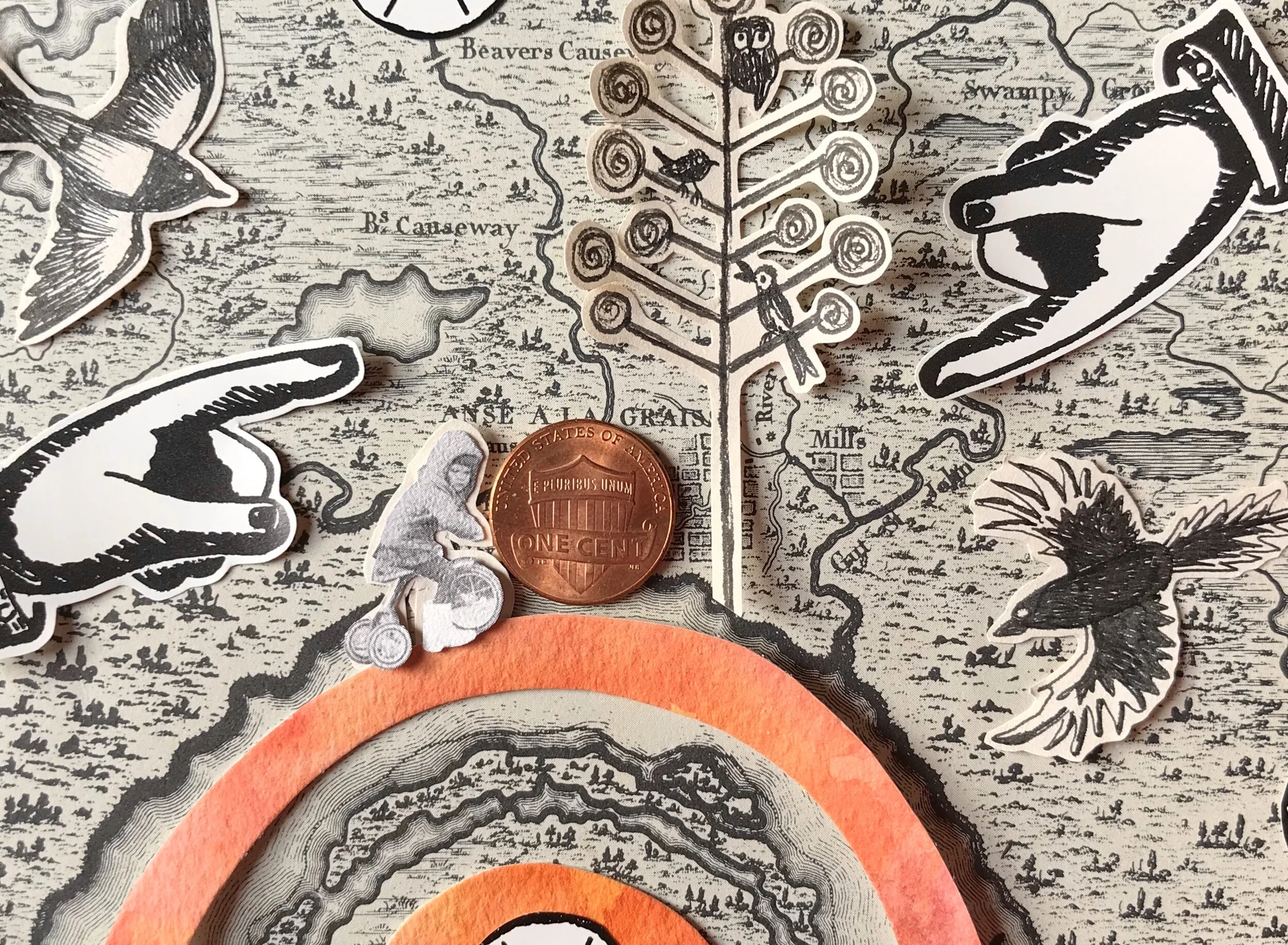
Nine years ago Benjamin worked as a barista. He loved the process of crafting drinks for people and it was the first time I heard about ephemeral art. He took great care to pull perfect shots, to steam the milk just right, and then to carefully integrate the two with a lovely design atop the latte. It’s a detailed visual craft that is appreciated for but a moment before the first delicious sip is savored.
I’ve thought a lot about his coffee craft these last few weeks as I’ve considered the kinds of collages I want to make. First and foremost, they must have cast shadows. This is a creative craving I’ve had for 13 years. As with any collage, I began with flat layouts, nudging each piece into its carefully chosen spot. But in this case, glue wasn’t a welcome medium since it would prevent the layered papers from laying naturally and casting shadows. I realized I had the opportunity to dance with ephemeral art if I avoided glue altogether, so I did.
The collages I’m creating are temporal. They’re created in that moment, shot with my camera, and then stored as separate tiny pieces in a small box in case they’re needed again for a future shoot. There’s so much I love about this. I love that so much thought and consideration goes into making a piece that in the end doesn’t physically exist. It’s made of tangible pieces and parts, but is captured in a photo. In the photo, the viewer can see the textures of the papers and the shadows cast by each layer… the rich texture invites the viewer in and creates a desire to reach out - to feel the textures and the edges. But it’s impossible to do so. The art lives in a liminal space… not fully flat, but not touchable either. Dancing with these concepts intrigues me.
My obsession with 3D collage began when I saw a book illustrated with all manner of 3D elements. Every bit of its visual richness encouraged me to reach out and touch the many textures, but when my fingers searched over the page, the page was, of course, flat.
These finished collages live in liminal space. They exist because you can see them, but not in the form the camera preserved them in. They have rich, textural feels, but not ones that you can touch with your fingers - the experience can only be felt with the eyes and imagined in the mind.
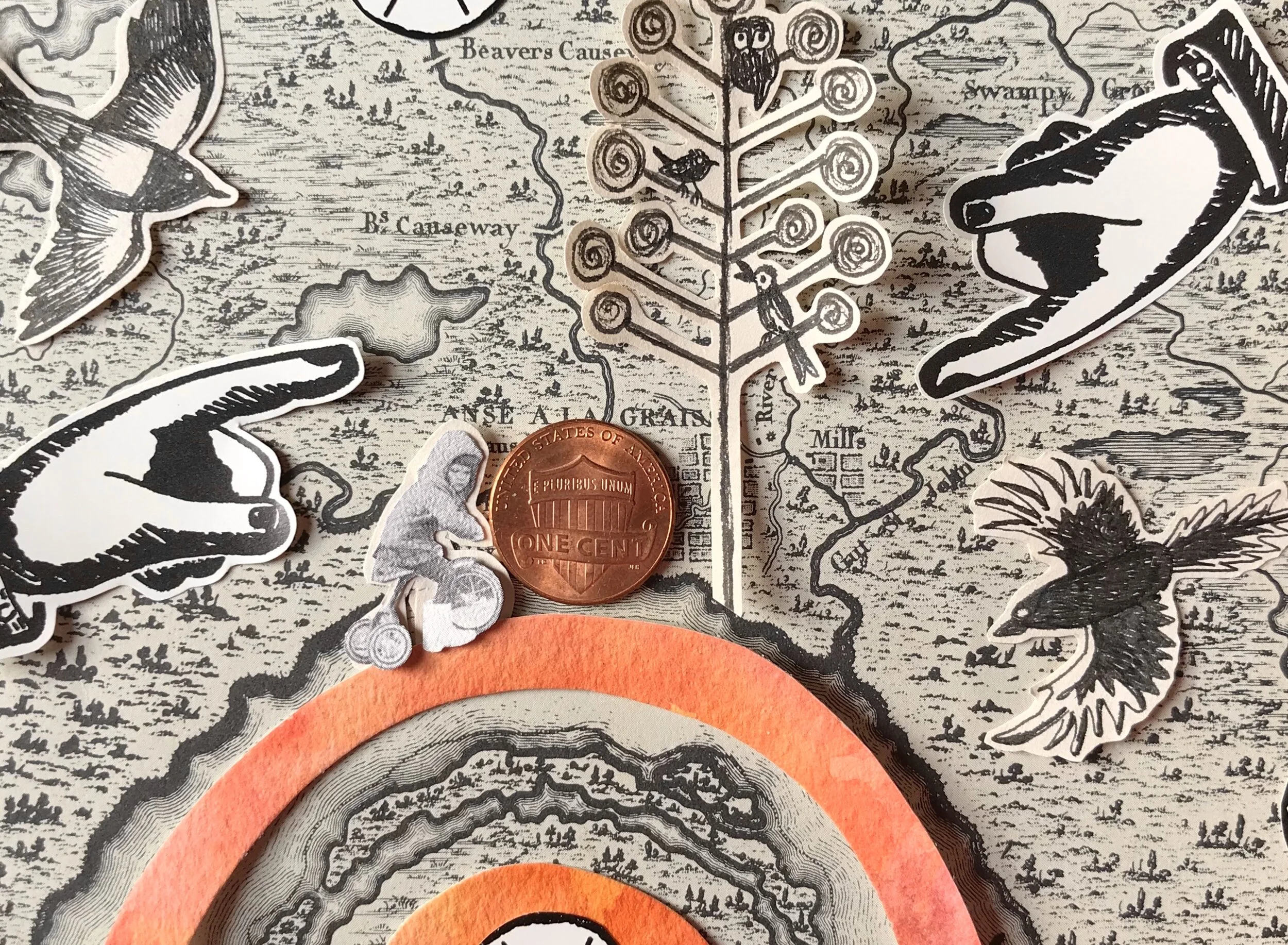
This piece is a wee one. The penny shows its small scale.
Adler, The Shoe
In truth, he was ugly. He looked like a shoe. I was surprised to find him sitting there, looking back at me from 20 miles away through my computer screen. His price point was higher than than I was accustomed to spending on his predecessors (two of which were free!), but not nearly as high as I expected given one of his unique qualities.
No sooner had I settled in with Maggie and Ollie last January than I turned to Benjamin and announced that I’d be needing to add a scripted font machine to our typewriter family. He wasn’t at all surprised. I’ve been keeping my eyes on the lookout ever since.
Script machines are harder to come by and therefore command higher prices - prices I couldn’t ever imagine myself spending. So when I saw this late-70s shoe machine listed locally for less than I expected, it gave me hope that I’d find the right one someday without selling off my spleen to afford it.
I routinely scan the online typewriter market to keep up with what’s going on, and this ‘shoe’ just kept sitting there. It wasn’t a brand I’d come across in my research yet, I couldn’t get over how tragically ugly it was, and I certainly couldn’t abide that it’s housing and case were made of plastic. Such a far cry from the gorgeous glass keyed elegance of Maggie, or the solid, weighty stance of Ollie, or the cheerful blue countenance of Webby!
But every time I went through my online perusal routine, there he sat, untouched. Almost a month had passed since he’d been posted and no one had bitten (probably bc he looked like a shoe). Finally my curiosity was piqued a little - just enough to see what other scriptwriters were available in the current market. There are many typeface variances from one typewriter to another and some are lovelier than others. But I discovered that an extra consideration when comparing script fonts is to ensure that the font is aligned properly so that the letters actually appear to join together as they should! The shoe had it, and his competitor didn’t. In fact there was very little about the shoe’s particular font styling that I was unsure about. The more I examined it, the more it seemed to be a really solid script styling.
Deciding that the realized dream of a useable script typeface was more important than outward appearance (so long as the inner mechanics were sound) I considered how much I was willing to pay to make room in my small studio space for the Shoe. I sent off an offer that was enough below the asking price that I felt grateful for an affordable entry-level script machine but not so low as to insult the seller. To my great delight he accepted (!), we made arrangements to meet, and after getting the approval from my personal technician (thanks, Benjamin!), we loaded up the shoe machine and brought him home.
Since my typewriter family has grown beyond the number of ribbons I have on hand, I pulled out Ollie’s ribbon to give the new arrival his test run (I admit it felt like a sort of betrayal, ripping out the voice box of a cherished heirloom and my oldest typewriter friend - for a typewriter has no voice without its ribbon - but, Ollie’s been awaiting a tuneup, so he’s been out of rotation. Still though, it was especially weird for me because it was going to the shoe, whom I do not love - more on that later).
My initial impressions of the shoe were mixed. On the one hand, I learned from the seller that he’s German-made - they are well known for their quality craftsmanship in typewriters. So I believe his guts to be good. His carriage is as smooth as butter. Seriously, I’ve never felt a smoother glide on a carriage. I also learned from the seller that the plastic construction was a modern-for-its-time evolution to reduce the weight of portables, and I have to say, this isn’t a cheap plastic. I never thought a plastic machine could impress me (and I will still forever prefer metal), but the feel of his body and case is solid, well-implemented, and should last well into future decades.
On the other hand, he’s terribly uncomfortable to type on. If I’d gotten him to use as a daily machine for long-form writing I would be very disappointed. The keys require such a heavy pounding that standard hand-posture is impossible and I had to use the hunt and peck method so I could really put some power behind my pointer fingers. Also, he looks like a shoe, but then I already knew that going into it!
What it all boils down to is that I’ve added a scriptwriter to my family at a reasonable cost and I couldn’t be more happy about that! Some preliminary online research speaks highly of this model, even specifically referencing its ease of typability, so I’m hoping that although his guts look great to the naked eye that a tuneup from Benjamin might help restore some ease of motion? Even if he’s this way forever, it’s no matter. He’s typeable with my modified approach (which I’m still fairly quick at, although it is more slow-going than the typical typing form) and I have others I can use for long-form typing. He will provide script font when it is called for and do it quite capably!
In summary, here’s what’s so fascinating to me about my experience with the shoe... It took the shoe to help me better understand my relationship with the other typewriters in my little family. I now see how my relationship with the others is akin to a romance. They are pure loveliness, light, and joy to me. I feel starry-eyed and effervescent just thinking about them. Typing on them is a joy even though they each have several eccentricities in need of tune-up (two of them haven’t been refurbished at all yet and Ollie needs a tune-up) - keys stick or a platen skips and won’t roll properly, but it’s all part of my relationship with them. I’m just in love.
Sometimes I fall in love with a typewriter that I don’t need that costs too much (for when I don’t need it, I can’t justify spending much at all on one). I may get a little lovesick for it and think about it for a few days, wondering if it’s alright, and if and when it will find a home - hoping it goes to a good one. These are all typewriter romances... from thrift store flings that I like flirting with but don’t bring home, to long term commitments to my family at home with all their quirks.
With the shoe it was different. There was no love at first sight. Until the shoe, I didn’t know that I could bring a typewriter into my life that I didn’t love. With the shoe it feels more like a partnership. It’s a professional relationship. We each bring things to the relationship: my creativity, his unique performance, and that’s it. It’s a relationship based on exchange. I provide a home and tune-ups for him because that helps him provide creative opportunity for me. He brings me script-font opportunities and I make sure he stays healthy and happy. It feels like a mutually beneficial partnership based in respect. For I do respect his craftsmanship and capabilities even if we disagree on design aesthetic!
So because I am filled with respect and gratitude for him, and because I’ve invited him into my family, I knew I had to stop calling him the Shoe and would need to give him a proper name. Adler is his manufacturer and I have to say it suits him, so Adler it is.
Welcome to the family, Adler. Thanks for teaching me things about myself and expanding my typewriter knowledge. Most of all, thanks for being a scriptwriter! I can’t wait to collaborate together - I already have some ideas!
A Typewritten Journey
My fascination with typewriters began about thirty years ago in the late-80s. A 1964 Olympia SM9 Portable sat on my grandparents’ desk and my little brother and I would play with it when we’d go for visits. I loved the feel of its sleek metal exterior, its responsiveness to my touch, the hammering and clicking sounds it made when I’d push the keys, and the cheerful ringing of the bell when the carriage reached the end of a row. We took much delight in using our small hands to mash all of the keys at once and watch the type bars all fly up and stick together then we’d carefully separate them one at a time. I didn’t understand what an unkind thing it was to do to such a lovely machine, I just liked the thrill I felt each time I did it!
By the mid-90s I was in junior high and feeling all those junior high feels. I had so many important things to say that were just bursting to get out of me! So I hauled my mom’s [very] heavy Smith-Corona Electra 220 back into my bedroom, locked myself in my bedroom, lugged the machine up onto my desk and proceeded to write my life story. Those documents were all mercifully burned by my mortified early twenty-something self, although my late thirty-something self feels more compassion towards my junior-high self and sure would like to see them again!
My high school papers in the late nineties were still written by hand. We didn’t get a family computer until my senior year of high school. High school isn’t really a time to appreciate the finer things or wax nostalgic or anything, and the excitement of computers eclipsed anything I might have ever felt for a typewriter anyway. Once I reemerged from the haze that was high school and college, I started thinking about typewriters again, but it was only in the last 10 years that I actively started looking for one. I’d browse online, become overwhelmed by too many options, and occasionally meet one in person that was either too dilapidated or not the right fit. Once, about six years ago, I brought one home, but it wasn’t the right fit for me and I put it back out into the world for someone else to find. Later, only 16 months ago, I eagerly brought home another typewriting friend only to discover it wasn’t a typewriter at all!
Unbeknownst to me, all would come together just two months later, and my typewriter education would begin with the surprising discovery of an old Underwood in my grandmother’s garage. Maggie Underwood is an extra special gal, not only for her sheer beauty and storied history, but because she was our first - the one who initiated me back into the joy of mechanically typewritten words and initiated Benjamin into the joy of restoring them. Just weeks later Ollie (the 1964 Olympia) showed up. As the first typewriter I acquainted myself with during my childhood, finding him tucked away in his forgotten spot was a joyful run-on for me.
Benjamin began refurbishing them, learning as he went, and gaining his own love for these well-crafted machines. Suddenly, typewriters were everywhere. Only a few weeks after I’d been typing away on Maggie we heard of an estate sale featuring more than thirty typewriters in Benjamin’s home town. They were all bought up by one buyer as soon as the doors opened, but that was no matter. We had an opportunity to walk around and see them in all their glorious diversity as the man collected their tags to check out. It was a feast for the eyes!
After that we continued to come across a few here and there during our Texas travels and acquired three more for Benjamin to refurbish and restore life to. While my passion lies in the use of the machines, his love is for the refurbishing.
Our powers combined, we began studying the typewriter market closely to learn more about the different brands, makes and models and the different features each could offer. He learned how to identify solid picks for refurbishment and I began to understand when and how I could use different models in my art practice. This learning’s been ongoing through the last fifteen months and we are both fueled by this shared adventure! We are just getting started and are so energized by our complimentary interests in these compelling machines.
Embodied Lives
My aunt died this morning after suffering through a terrible degenerative disease that I don’t think any of us ever fully understood.
The last time I saw her she was making apologies for her “alien arm” - so called because she no longer had any control over its sporadic movements. She apologized for it each time I got too near her. I didn’t like to see her fretting over her arm’s uncontrollable behavior even as she had difficulty walking and forming words. So I asked about the grandkids and what they thought about the diagnosis the doctors had given her arm, reminding her that an “alien arm” sounds like a pretty amazing thing to have through the eyes of her beloved grandkids. She mentioned that when my uncle, a known curmudgeon, is helping her she sometimes hits him with her rogue arm. I joked that he probably deserved it and we all got a chuckle out of that. That was eight months ago, and now she’s gone.
Last spring, I was managing my own insecurities about a body being affected by illness that I didn’t know how to control. In November I began using an app to help me track my water intake after discovering that chronic dehydration was a significant contributor to my health challenges. Each morning I start my day with the same beloved routine: after washing my face and brushing my teeth I put the kettle on and make a cup of herbal tea. I return to my bedroom, push back the lace curtains, greet my garden, and sit in my floral chair by the window. I read a book as I sip my tea. Once I finish my tea, it’s time to make breakfast and fill my first water bottle for the day. The ritual of making tea and filling my water bottle are what start my hydration mindfulness each day.
But this morning I woke up to the text with the news of my aunt’s death - so I lingered in bed all morning thinking about her and intermittently playing a game on my phone and watching tv so as not to be alone with my thoughts. The house is empty today with my housemates either at work or home for the holidays and so the house felt especially still and quiet. Then, having long tired of television or games, but without the gumption to rise, I received a text from a friend inquiring about the water tracking app I’ve been using. Opening the app and seeing that it was after 11am and that I was at 0%, I felt my resolve to start my day rise up. I love my morning routine. I anticipate and look forward to it at the close of each day as I fall asleep. The inquiry from my friend reconnected the circuit to that enjoyment and roused me from my cocoon.
As I began my morning routine I considered the oddity of life after a death. My aunt is gone. Someone is missing and has left a hole in the world where they should be. She’s always been there, my whole life, and before my life began. She’s the first of my parent’s generation to leave us and a reminder that more of them will follow as time moves on. These are all of the things that I contemplated (or avoided thinking too much about) as I lingered in bed this morning. And yet… my body still needs to be cared for. She (my body) still needs me to go through my morning rituals to set myself up for a good day. She needs me to hydrate and feed her and to stretch out her sore, stiff muscles after a week of intense activity. There’s a cognitive dissonance there: the cosmos has shifted and someone is gone who shouldn’t be, and yet I still need to concern myself with the temporal business of brushing my teeth, making my cup of tea and other simple routines. But it’s these rituals that ground me and keep me from contemplating current and anticipated losses too hard, so really it’s a mercy that these acts of living must not be overlooked.
I don’t want to over-inflate my experience of losing my aunt. I come from a small extended family that’s not close. Each branch carefully keeps to itself. But still, in a family that’s scattered about and got together only sporadically throughout the years, this aunt was the one who loved me best. She always loved me well and showed me kindness when I saw her. She’s the one who taught me how to pet a dog (stroke them gently in the same direction as the fur). She had a beautiful smile and a warmth to her and you don’t have to see someone often or know them well to miss them all the same. I’m sad that she’s gone and that she suffered in her later years. I’m sad because fresh losses always stir up remembrances of previous losses. And I’m sad because her death is a reminder that the inevitable march of time will keep taking others in her generation away from us.
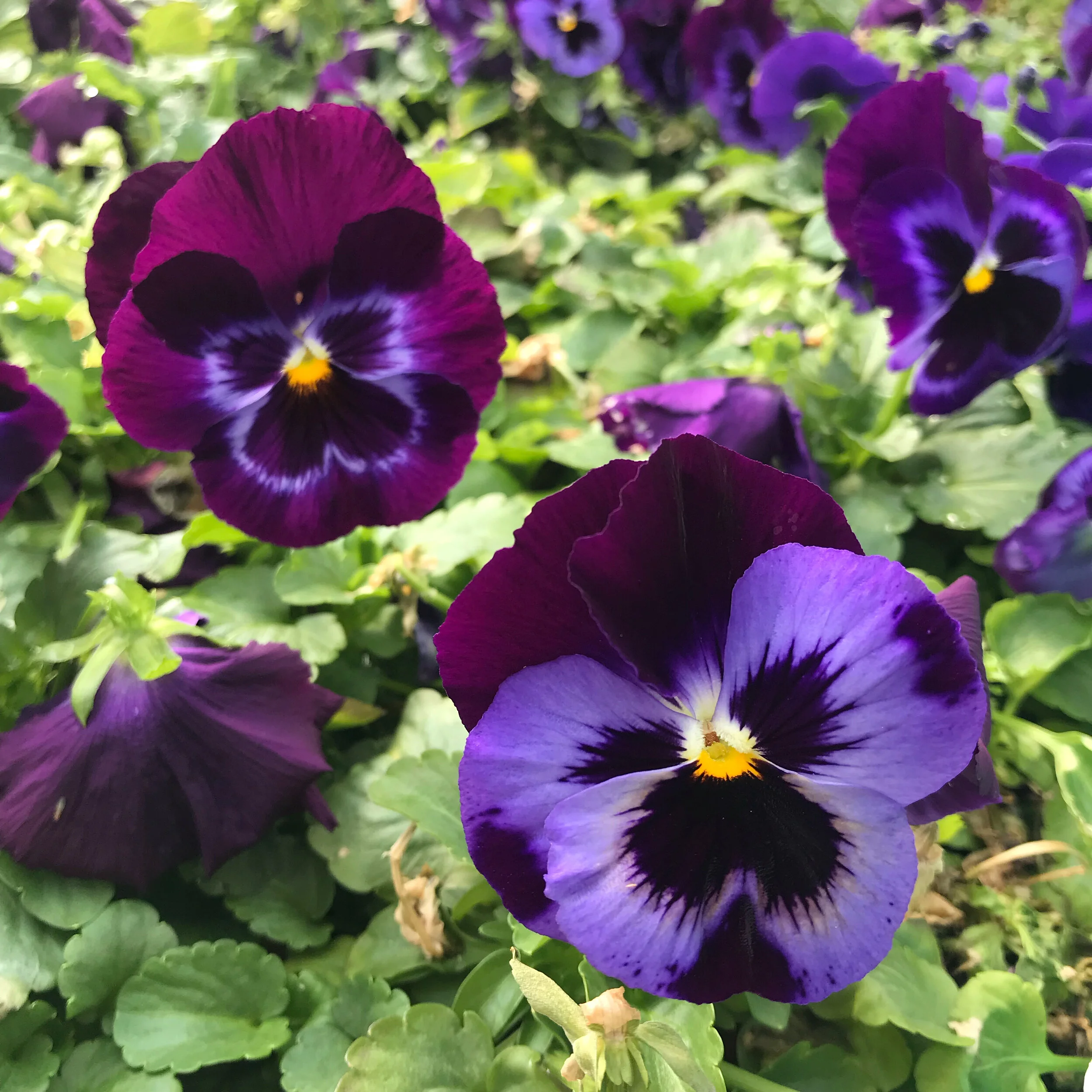
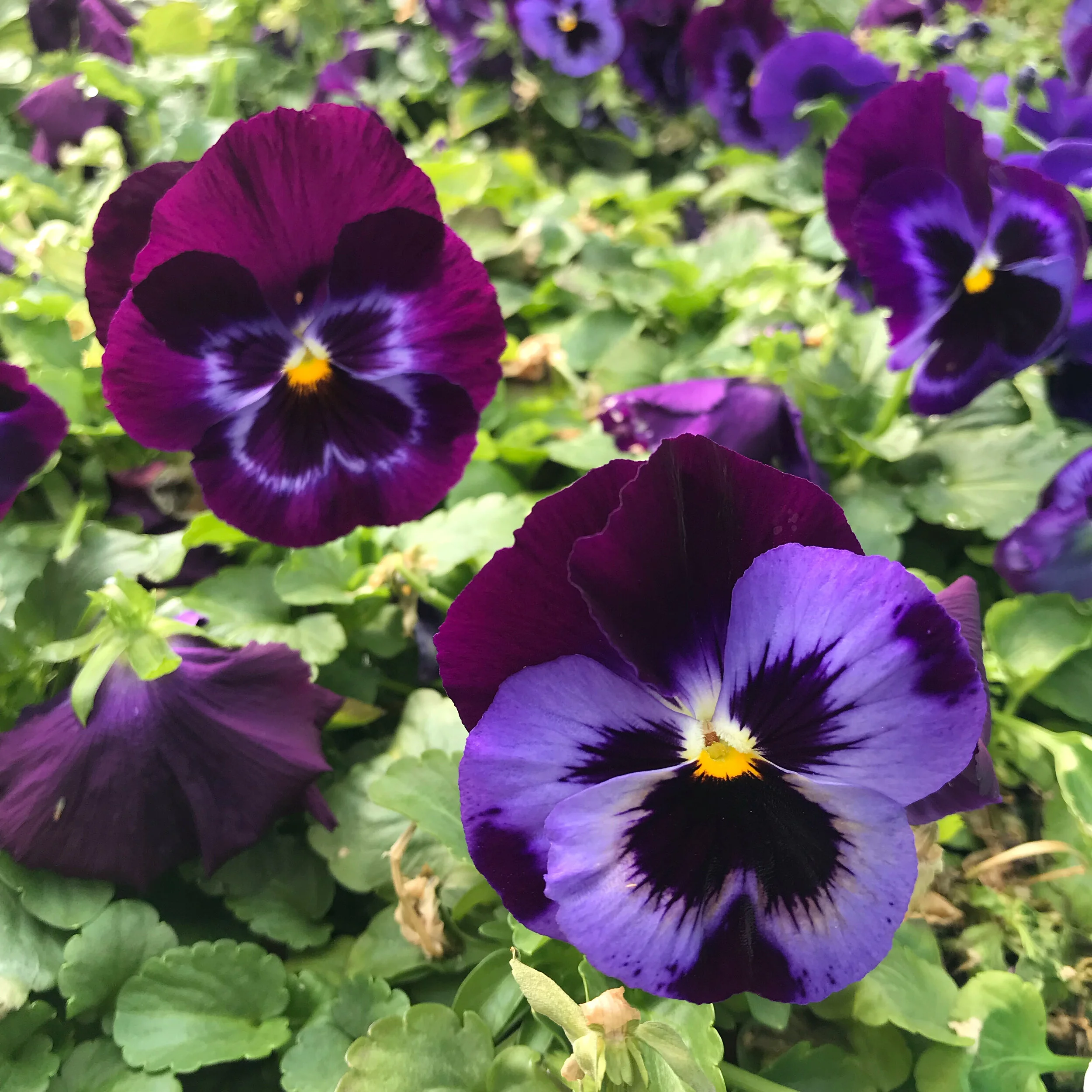
But I’m also grateful for friends who text with app inquiries, for cherished, simple morning routines, and for muscles that ask to be tended to and stretched out. I’m grateful for the cheerful faces of colorful pansies to greet me outside my window and for hot, herbal tea to warm my insides and whet my appetite for breakfast. While my thoughts may stray far into the cosmos today, I will tend to my body well, which will keep me grounded and prevent me from spinning off too far into the what-if thoughts of grief. Bodies certainly give us some real trouble sometimes, but they’re also faithful companions that keep us humble and rooted in the present moment. Today I’m finding myself deeply grateful for my embodied state and for being able to turn my focus towards my physical needs, which will crop up like clockwork all day long. Each prompt from my body is an invitation to a meditative practice, in the physical realm, to keep me from dwelling too much in the messier parts of my head.
Stardust Memories
Willie Nelson released his album Stardust in 1978, five years before I was born. In 2007, I ordered the album on CD for my dad, as a replacement for his old vinyl copy and I heard it for the first time. At first, I listened to the album because it was a way to feel closer to my dad, but in no time at all I grew to love the album as my own, and I began to love Willie as well and stretched my listening into other albums. He now has the biggest presence in my music collection by a wide margin - (I buy every Willie cassette I come across) - and is my second favorite artist of all time.
Last October Benjamin and I loaded up and headed south for the winter. We spent the majority of our time in Texas, six months in fact, and spent our time there traveling to many of its remote corners. Despite us both being born and raised in Texas, I’d never seen Big Bend, he’d never seen the Texas coast, and neither of us had ever ventured deep into the south into the Rio Grande Valley. We remedied that during our travels while also enjoying much time in the Hill Country and the Panhandle as well.
These travels were transformative and these places crawled in and nestled themselves under my skin and in my heart. They became a part of me. And since returning to the Pacific Northwest, I admit I’ve been homesick for Texas, sometimes deeply.
I miss Big Bend in springtime during a superbloom when the whole desert was filled with unexpected color: vibrant bluebonnets filling the foreground of the landscape with the vibrantly colored, red, brown, and purple Chisos mountains providing the backdrop, gray-green prickly-pears with frilly, vibrant yellow and prink blossoms, rainbow cacti dressed in colorful stripes and topped with flowers, and yuccas of all kinds dotting the landscape and topped with fluffy, cream-colored blooms. The mesquites were a fresh spring green against the bright blue sky and filled with the song and flashes of color of songbirds and woodpeckers we’d never seen before. The cottonwood grove held a sleeping long-eared owl bobbing on its windswept perch.
I miss the Rio Grande Valley with all of its stunning wildflowers and spectacular birds. The gulls laughed at me as we camped along the Arroyo Colorado. A single great blue heron, so bountifully seen in great numbers at the nesting site near our previous home, and still I was impressed with its majesty. The shore birds bobbed and weaved as waves rolled in and out from the gulf. Green jays eluded us, hiding adeptly in the trees and filling the air with their calls. Vibrantly colored kingbirds flitted through the trees and hawks circled high above the treeline along their migratory corridor.
I miss the long stretches of sandy beaches along the preserved portion of the Texas seashore. The shoreline is free of rocks and the water is warm. The waves roll in long and low and are perfect for gliding into shore on. While the PNW coast has its own indescribable beauty, the Texas coast is for frolicking like a carefree child. I did just that and it was magical.
I miss the Hill Country whose beautiful rivers carve through soft, white limestone and the majesty that comes with knowing that flash floods can appear suddenly even on the sunniest of days and turn a tranquil stream into a deadly torrent in mere minutes while raising the water-level many feet up into the trees. I miss the cedars [they’re actually ashe junipers, but everyone calls them cedars] that cover the landscape with their reddish bark and dark green canopies. Golden-Cheeked Warblers call these trees home during the breeding season. They only nest in central Texas, nowhere else, and are increasingly uncommon due to habitat loss. On our last day there, we spotted a nesting pair of these beautiful birds, a birding dream come true. I miss the wildflowers covering the highways of west Texas with extravagant carpets of color, mostly in shades of bluebonnet blues and paintbrush reds, with smatterings of yellows, maroons and primrose pinks.
I miss the wide skies filled with painted sunsets and endless stars. We savored these skies in Big Bend, in the valley, along the seashore, in the Hill Country, in the Panhandle, and in west Texas. I began to know constellations, planets, and star clusters in those winter-spring skies - celestial friends inaccessible to me in the cloud-covered, light-filled city that I call home in the PNW.
And, I miss my family and the land that’s been tended by them for four generations. I miss long visits with my grandmother and the stories she would tell me about local and family history. I miss my mom cooking meals for us in the kitchen while my dad watches TV. I miss the large and wild garden outside of the guest-room window - tended by my mother and started by her grandmother. I miss the birds that gather there at the feeders and bath, some of them coming right up to the window to peer inside. I miss the lilac bushes and honeysuckle that have grown there my whole life and the pecan trees planted by my great-grandparents and grandfather. There are the friendly springtime weeds I used to pick bouquets of as a child, mistletoe growing in mesquite trees, a garden, several fruit trees, and my decrepit old treehouse, long since unfit for occupancy. I know the plants, the land, the people there, and I miss them.
This past weekend I took a collage class and intended to make a couple of gorgeous prickly pear illustrations my main subjects. As I endlessly cut around the tiny spines I considered how I might like to feature them. I found myself once again contemplating the homesickness I’ve felt for these pieces of Texas that integrated into me and began to consider an homage of sorts to our travels.

The idea of the bird came first, then the music which ties into the birdsong. After delicately cutting around the small cactus spines all day, I headed to the thrift store that evening seeking music for the piece that was evolving in my head all day. I was most surprised and delighted to find a stack of vintage sheet music at the thrift store that evening - and in that stack: Stardust. I knew I’d found the song to best share all of my memories and missing of our Texas travels. The next day I tore the star-filled cover and music notations it into strips, retyped the lyrics (so I could position them beneath the music just as I needed so they would show in-between the cactuses and be readable) and selected words to create a beautiful poem out of the song lyrics, laid out with its music.
A star-filled sky, yellow-flowered prickly pears, and a golden cheeked warbler. A fitting tribute to these memories I savor and the places (and inhabitants) that I miss.
little stars
away,
meadows of my heart.
Life Transitions: Sixth Grade, Age 11
This is the first post in an upcoming series about Life Transitions.
My childhood home was just across the street from the school that I attended for six years, K-5th. Our front yard overlooked the playground which sat just in front of the low-slung campus with its outdoor, open-air sidewalks. The playground was wild then - all wood pieces and metal bars - a series of exercise stations that some civic-minded member of the community no doubt thought would be a lovely addition to the neighborhood. During recess we would make our own fun on these strange boards, flat and sloping, interspersed with metal bars at all different heights. We’d fall and scrape our elbows and knees in the sand below. Near the fence, on the edge of the playground, tires of different sizes were buried into half-moon circles sticking up above the ground. Each tire was painted in its own bright color and every one had its own personality of texture - some were firm as rock and others were so squishy that my child-sized weight would sink my foot down into them.
Elementary School After Hours
During evenings, weekends, and summers my brother and I would ride our bikes up and down the open-air sidewalks of the school and make figure-eights on the concrete slabs where outdoor P.E. classes were held. We’d explore parts of the school we never saw when classes were in session - like the teachers’ parking lot behind the cafeteria where a large mulberry tree grew. Its roots spread out under the asphalt to create a hump in the roadway, which was a particular joy to ride our bikes over. In the sun-drenched west-Texas landscape, this shady spot behind the school felt like a secret oasis in which we could cruise around on our bicycles.
On the opposite side of the school there were a couple of smaller mulberry trees. These trees were good for climbing so, leaving our bikes in the grass near the portable buildings, we’d climb up into the limbs to view the familiar landscape from yet another strange, new vantage point. One evening as I sat in one of the small mulberry trees on the side of the quiet school, my mom stood below and fed me my first almonds. I loved them, ate too many, and gave myself a tummy ache. I didn’t eat almonds for years after that.
My dad taught me how to ride my bike in the empty field next to the school, just beyond those climbing trees. My tires were always full of stickers from the mean goat-heads that grew in the dry, yellow grass and my dad was forever patching holes in my tires. Unconfident in my ability to maneuver my bike (or use my brakes), I’d pedal furiously across the field yelling ‘I’m dead meat! Dead meat!!’ as he’d jog along behind me until I’d crash into the chainlink perimeter and he’d get me started all over again.
The school was our private playground any time it wasn’t in session. We’d peek into classrooms and marvel at how quiet, dark and still they were. We were so much better acquainted with them bursting with the noise and bustle of lessons and activities.
The Watching Went Both Ways
My house was just across the street from the chainlink fence that ran next to the strips of rainbow tires. I was six years old and playing during recess when my older brother came out the front door of the house one day to head to his college class across town. I ran across the playground and into the chainlink fence, yelling his name and waving furiously. I was so proud and delighted that I had the privilege of seeing my cool, big brother during the middle of the day. None of the other kids got to do that! When we got a new roof one year, I watched curiously from the vantage point of the playground as they loudly worked on our house. It was a strange thing to see them pounding away on our roof and throwing shingles around.
When my little brother had a seizure, my mom called the ambulance. It was all very scary and I didn’t really understand much of what was going on, only that my mom was very stressed and scared. I remember the emergency personnel laying him out on the kitchen table and cutting off his teal green shirt so they could work on him. The next day, concerned grown-ups at the school asked me if my family was alright, because they’d seen an ambulance at our house. I knew even then that it was a pretty special thing for them to show that kind of care and concern, and that it was all because we lived right across the street.
The watching went both ways. Our driveway ran alongside the house and into the backyard. From my climbing tree in the backyard, I could look down the driveway and have a straight-shot view of the school playground across the street. Kindergarten was still half-day when I went and I remember playing in the backyard and watching the older kids playing on the playground past the end of the driveway.
During the Spring of my first-grade year, I was home and in bed with pneumonia. My bedroom was situated in the front of the house and my bed faced the front window in my room. As I laid propped up in bed, I watched kids come and go from P.E. classes on the slab and from recesses on the playground next to it. Although I was told I was quite sick, I certainly didn’t feel it, and it felt surreal to be sitting in my bed on such a sunny day and and watching the world go by without me.
My elementary school was a nurturing space filled with teachers and relationships that I’d cultivated over my six years there. I’d watched the life of my home from the playground and I’d watched the life of the school from my backyard and bedroom. Others had watched the life of my family and knew my cool big brother and knew when we were in distress. It was my private playground to explore with my brother and parents after hours and it was where I grew from childhood into my pre-teen years.
Starting Sixth Grade
In August of 1994, I began my first year at Lincoln Middle School. I was 11 years old. For all of the six years of my elementary education I’d attended the friendly elementary school across the street. Suddenly, with the start of the new school year, I’d aged out and leveled up to the middle school across town. As it goes with these sorts of things, I had no say in the matter.
Nothing could have prepared me for the difficulty of this transition. How does one make sense of going from a place that feels like an extension of your home, filled with people who know you personally and love you well, to a foreign place across town? The school was large and three stories tall. I had a schedule and moved from classroom to classroom. There were lockers to visit between classes and combinations to remember to get into them. Instead of one classroom and one teacher, I had 8 classrooms and as many or more teachers. There was no hand-holding or nurturing or empathic care; I was all alone in this strange new world. My best friend (who had serendipitously been in all the same classes as me from K through 5th) was now on the other ‘team’ [each grade level was divided into two teams] which meant that all of our teachers were different. Not only were we not in the same rooms, but we didn’t share any of the same teachers or classes. I felt really and truly on my own.
From my earliest memory, I was a nervous child, predisposed to anxiety. My childhood was filled with one upset tummy after another: nerves about social situations, nerves about competitive environments. Invitations to birthday parties were fraught with upset tummies and desperately wanting not to go. But moving into middle school was by far the scariest, most traumatic transition I’d ever faced.
I shut down. My stomach was so upset with the fear of it all that it couldn’t hold food. Every time I ate I threw up - so I stopped eating. Each morning my mom would encourage me to eat a little something, and every morning I’d throw up before school. I didn’t weigh much to begin with so when I started losing weight, she took me to the doctor, then to the school counselor. But no doctor can make a nervous tummy take food. And no eleven year old has the words to articulate the paralyzing fear of this life transition to a well-meaning counselor who didn’t know what to do with me.
My mom started packing me lunches of saltine crackers, applesauce and ginger-ale - anything my stomach might take. I’d sip a couple of sips of ginger-ale at lunch, but that was it. I had no appetite and my stomach was in knots. Although I’d forgotten, my aforementioned best friend reminded me only days ago that I was eating Tums all the time back then. I’d forgotten about that. Eleven years old and popping Tums just to try to cope with daily life. Bless my sweet little eleven-year-old heart.
Even now, I can’t fully understand the terror that I felt at the time. It was just the cumulative shock of being transplanted into such a foreign and inhospitable environment. The eighth grade boys looked more like grownups than kids (my mom tells me I was very alarmed that some of them had facial hair). The hallways were noisy and the stairwells echoed loudly. People bumped into you as they shuffled past you in the hallways to get to class- full sensory overwhelm.
I felt completely on my own in navigating my schedule, getting everywhere I needed to go, and keeping all my ducks in a row. I completely and utterly shut down. I didn’t eat because I couldn’t. I didn’t talk about it because I couldn’t. I didn’t have the words because I didn’t even understand what was going on. It was all too disorienting and overwhelming. Transplant shock is the only way I know how to describe it.
I wish I could say that I found a magical way out of this dark and confusing time. But in truth, I started eating again because my mom became so fearfully desperate for my health that I became more frightened of my panicked mother (when one morning on the way to school she outburst her tearful worry and her frustration at not being able to fix it) than I was of this strange, overwhelming school. Weirdly, the fear of seeing my mom like that was what got me eating again. I couldn’t do anything to change my situation at school, but I could change the situation with my mom by eating. Eating would at least solve that one problem. So I began to eat.
All of this took place in the opening weeks of starting at this new school, with new kids, and older students. As I settled in, I made friends and enjoyed my time there. I became acquainted with the routine and learned how to manage my schedule and new class structure. I found nurturing relationships with some teachers and not with others, but realized that the benefit of having more than one teacher is that I could savor the really good ones and not spend as much time with the others. (When I had a rough time with a teacher back in elementary school, I was stuck with her for the whole year! I learned it was nice to mix it up a bit).
While starting the sixth grade was my first major difficult life transition, there have been many others since then. (Sixth grade was followed by the sudden death of my grandfather, moving across the state when I was a freshman in high school, starting college, getting married, moving across the country, moving into a van for travel). Each one was difficult for me and presented unique challenges, and left me feeling debilitated as I blindly sought a way forward. Each time I’m in it, I can’t see a way out. But having now survived each one, I can look back and see how each experience has taught me more about myself and helped me build resilience.
When the next difficult life transition rolls around, I won’t be able to see my way out of that one either. But with good people around me to remind me that I’ve survived before, and can survive again, I’ll find my way through.